

What is a fiber optic drone? It is an unmanned aerial vehicle (UAV) that uses a physical optical fiber cable to transmit flight commands, live video, and other information instead of relying entirely on wireless radio signals. This communication method offers resistance to electromagnetic interference while introducing unique physical and operational challenges.
Although fiber optic drones have gained attention in military aviation, optical communication also has applications in industrial monitoring, emergency response, telecommunications, and scientific research.
Understanding their technology, capabilities, and limitations helps explain where these specialized aircraft fit into the future of unmanned aviation.
What Is a Fiber Optic Drone?
A fiber optic drone communicates with its ground control system through a physical optical cable that carries information using light signals.
Depending on the system, the connection can transmit:
- Flight control commands
- Live camera footage
- Aircraft telemetry
- Sensor information
- System status updates
Unlike traditional drones that generally depend on radio-frequency communication, fiber optic aircraft use a wired optical connection for some or all of their data transmission.
However, optical communication does not automatically improve every aspect of aircraft performance. Flight endurance, navigation, safety, and mobility remain separate engineering considerations.
How Does a Fiber Optic Drone Work?
Fiber optic drones combine conventional aircraft technology with optical communication equipment. Their motors, cameras, and flight controllers perform familiar aviation functions, while the optical connection handles data transmission.
According to the Fiber Optic Association, optical fiber contains a light-carrying core surrounded by cladding. Light remains guided within the fiber through a principle known as total internal reflection.
At a fundamental level, optical communication involves three stages:
- Electronic information is converted into optical signals.
- Light signals travel through the optical fiber.
- Receiving equipment converts the signals back into electronic information.
This process enables communication between the aircraft and ground equipment. Unlike radio transmission, the information carried through the optical fiber does not require a wireless propagation path.
Communication reliability nevertheless depends on the condition of the cable and associated equipment.
Where Does the Fiber Optic Drone Cable Come From?
The cable arrangement depends on the aircraft’s design.
Spool-fed drones carry optical fiber on an onboard reel, while commercial ground-powered tethered drones remain connected to a ground station.
The distinction matters because an optical fiber primarily carries information, whereas a powered tether may incorporate separate electrical conductors that supply energy.
Consequently, having a fiber optic connection does not necessarily mean that an aircraft receives power from the ground.
What Is a Fiber Optic FPV Drone?
FPV stands for First-Person View, allowing operators to view live footage captured by an onboard drone camera. A fiber optic FPV drone uses a physical optical cable to transmit information rather than relying exclusively on wireless radio signals.
While FPV describes the operator’s viewing perspective, fiber optics refers to the communication method used to exchange data between the aircraft and ground control equipment.
FPV technology does not exempt civilian drone operators from applicable visual line-of-sight regulations.
Main Components of a Fiber Optic Drone
Fiber optic drones share several essential components with conventional unmanned aerial vehicles (UAVs), but their optical communication system distinguishes them.
| Component | Primary function |
|---|---|
| Aircraft frame | Supports aircraft components |
| Motors and propellers | Generate lift and movement |
| Flight controller | Manages flight operations |
| Optical fiber | Transmits communication data |
| Optical transceiver | Converts electronic and optical signals |
| Camera | Captures live video and images |
| Power system | Supplies electrical energy |
| Ground control system | Enables aircraft control and monitoring |
Together, these components support aircraft operation, data transmission, and communication between the drone and its ground control system.
Types of Fiber Optic Drones
Fiber optic drones can be grouped into three main categories based on their communication technology and power arrangements.
- Spool-Fed Fiber Optic Drones: Carry an onboard optical fiber reel and generally rely on batteries for power.
- Ground-Powered Tethered Drones: Connect to a ground station through a physical tether, which may provide both optical communication and continuous electrical power.
- Hybrid Communication Drones: Combine optical connections and wireless communication technologies for specialized aerial applications.
These categories describe technical configurations rather than formal aviation classifications.
Fiber Optic Drones vs. Traditional Drones
Fiber optic drones differ from traditional wireless drones in communication technology, mobility, power requirements, and operational limitations.
| Feature | Fiber optic drone | Traditional drone |
|---|---|---|
| Communication | Optical cable | Wireless radio signals |
| RF interference | Optical link resistant | Susceptible to interference |
| Mobility | Cable-constrained | Greater flexibility |
| Physical cable | Required | Not required |
| Equipment | Optical communication hardware | Wireless hardware |
| Connection failure | Cable or equipment damage | Signal loss or equipment failure |
| Flight endurance | Depends on design and power supply | Typically battery-dependent |
| Applications | Specialized operations | General-purpose aviation |
Traditional drones offer greater mobility, while fiber optic drones provide an alternative communication method with resistance to radio-frequency interference. The better choice depends on the intended application and operating requirements.
Key Advantages of Fiber Optic Drones
Fiber optic drones offer several communication and operational benefits, particularly in specialized aerial applications.
- Resistance to Electromagnetic Interference: Optical signals resist radio-frequency interference, although other onboard electronics may remain affected.
- High Data Transmission Capacity: Supports high-bandwidth communication for live video, detailed imagery, and sensor information.
- Reduced Dependence on Wireless Communication: Uses physical optical cables as an alternative to conventional radio-based data transmission.
- Extended Flight Duration: Certain ground-powered tethered models support prolonged aerial operations without relying entirely on onboard batteries.
- Enhanced Communication Privacy: Physical optical connections reduce exposure to wireless interception, although encryption and cybersecurity measures remain essential.
Do Fiber Optic Drones Provide Better Video Quality?
Fiber optic communication can support substantial data transmission capacity, but it does not automatically guarantee superior video resolution or zero latency.
Video performance depends on camera quality, image processing, compression, communication equipment, and display capabilities.
Latency is the delay between capturing an image and displaying it to the operator. Even when an optical connection provides sufficient bandwidth, processing and decoding can introduce delays.
Therefore, video quality must be evaluated across the entire imaging system rather than the optical cable alone.
Disadvantages and Limitations of Fiber Optic Drones
Despite their communication benefits, fiber optic drones have several physical, operational, and environmental limitations.
| Limitation | Potential impact |
|---|---|
| Cable damage | Partial or complete loss of communication |
| Additional equipment | Increased aircraft weight and complexity |
| Restricted mobility | Cable-related movement constraints |
| Maintenance requirements | Specialized servicing and additional expenses |
| Weather exposure | Reduced operational reliability |
| Environmental waste | Discarded optical fibers and potential wildlife hazards |
Reliable optical communication does not eliminate other aviation risks, including mechanical failures, power interruptions, navigation problems, and adverse weather conditions.
How Much Does a Fiber Optic Drone Cost?
There is no universal price because fiber optic drone systems vary considerably in design, equipment, and intended application.
Major ownership expenses include:
- Aircraft and optical communication equipment
- Ground control infrastructure
- Power supply systems
- Maintenance and replacement parts
- Operator training and insurance
- Regulatory compliance
Organizations evaluating commercial tethered aircraft should consider total ownership costs, including staffing, maintenance, and downtime.
Reliable pricing requires a quotation for the particular system. An advertised aircraft price may not include all equipment or recurring operating expenses.
What Are Fiber Optic Drones Used For?
Fiber optic drone technology supports various specialized aerial applications, particularly through ground-powered tethered systems. Some applications are commercially established, while others remain experimental.
- Industrial Monitoring: Provides sustained aerial observation of construction sites, industrial facilities, and infrastructure.
- Emergency Response: Supports disaster assessment and emergency response coordination.
- Telecommunications: Offers potential aerial communication platforms in areas with limited network infrastructure.
- Scientific Research: Supports environmental monitoring, airborne sensor experiments, and data collection.
- Public Safety: Enables authorized aerial observation during public events and emergency incidents, subject to aviation and privacy regulations.
Why Are Fiber Optic Drones Becoming Popular?
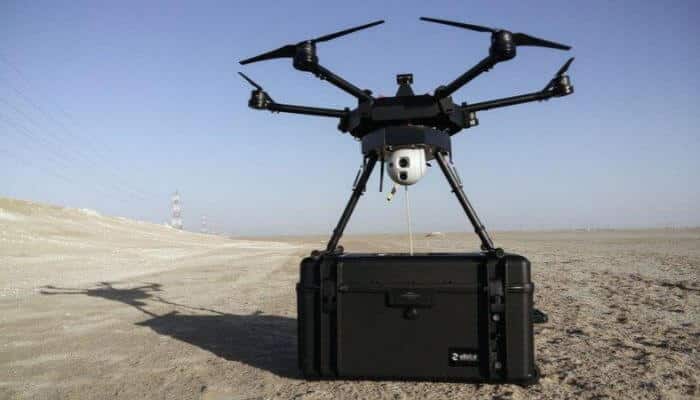
Military use during the Russia-Ukraine war has brought significant public attention to fiber optic drone technology.
However, its broader technological importance extends beyond that context. Optical communication demonstrates how aircraft can exchange information through an alternative to conventional wireless networks.
Commercial tethered systems and experimental optical communication platforms illustrate different development paths.
Growing public interest should not be confused with widespread civilian adoption. Many commercial applications continue to favor conventional wireless drones because of their flexibility and established operating models.
How Far Can a Fiber Optic Drone Fly?
The flight range of a fiber optic drone depends on aircraft design, power availability, cable constraints, environmental conditions, and aviation regulations. There is no universal operating range for these aircraft.
| Measurement | Meaning |
|---|---|
| Cable length | Total available optical fiber |
| Flight distance | Actual distance traveled by the aircraft |
| Operating range | Practical distance within operational limits |
| Flight duration | Total time spent airborne |
Cable length alone does not determine flight range. Continuous ground power may extend flight duration in tethered models, but physical constraints and operating conditions still limit their capabilities.
Do Fiber Optic Drones Need GPS?
Fiber optic communication and GPS perform different functions. Optical fiber carries information, while the Global Positioning System provides positioning and timing information.
Using an optical connection does not automatically eliminate the need for satellite navigation. GPS requirements depend on the aircraft’s navigation and flight control design.
Reliable communication and accurate positioning should be evaluated separately.
Can Fiber Optic Drones Fly Without a Battery?
Ordinary optical fibers primarily transmit information rather than supplying electrical energy to aircraft motors.
Spool-fed drones generally depend on onboard batteries. Some ground-powered tethered aircraft receive electricity through conductive elements incorporated into their tether and may retain batteries for backup purposes.
Therefore, an optical data connection alone does not provide continuous electrical power.
Real-World Examples of Fiber Optic Drone Technology
Fiber optic drone technology is being explored through commercial tethered systems and scientific research.
Elistair SAFE-T 2
The Elistair SAFE-T 2 is a commercial tethering station that provides continuous ground power to compatible drones, with optional fiber optic connectivity for data transmission. It demonstrates how optical communication can support extended aerial observation, industrial monitoring, and public safety applications.
Optical Communication Research
A study titled Mobile Optical Communication Using a Fiber-Optic Drone, published in Optics Express in October 2026, investigated an experimental aerial optical relay system capable of real-time data transmission.
The research highlights potential telecommunications applications, although further development is necessary to establish commercial viability.
Are Fiber Optic Drones Better Than Wireless Drones?
Neither technology is universally superior. The best choice depends on operational requirements, mobility, flight duration, and communication needs.
For example, a construction company may consider the following options:
| Business requirement | Suitable technology |
|---|---|
| Site photography | Conventional drone |
| Continuous site monitoring | Powered tethered drone |
| Aerial mapping and surveying | Conventional drone |
| Extended aerial observation | Powered tethered drone |
Conventional drones offer greater mobility, while powered tethered drones are better suited to sustained observation. Businesses should also evaluate equipment costs, staffing expenses, maintenance, and whether fixed cameras could provide a more economical solution.
Environmental Impact and Safety Concerns
Discarded optical cables can create environmental and wildlife hazards, particularly in areas where spool-fed drones are extensively used.
On June 30, 2026, Reuters reported that birds in Ukraine were incorporating discarded drone cables into their nests, raising concerns about wildlife entanglement.
The Fiber Optic Association also identifies sharp glass fragments as potential safety hazards. Responsible operations should prioritize professional maintenance, material recovery, and proper waste disposal. Abandoned drone equipment in conflict-affected areas should remain untouched and be reported to authorities.
Are Fiber Optic Drones Legal?
The legality of fiber optic drones depends on the country, aircraft classification, airspace, and intended application. In the United States, the FAA’s Part 107 regulations govern many commercial small-drone operations.
Applicable requirements may include:
- Aircraft registration.
- Remote pilot certification.
- Visual line-of-sight requirements.
- Airspace authorization.
- Flight and safety restrictions.
Fiber optic connectivity does not exempt aircraft from aviation regulations. Operators must comply with applicable laws and obtain necessary approvals.
The future of fiber optic drone technology will likely focus on communication reliability, aircraft efficiency, environmental sustainability, and specialized commercial applications.
Advancements in optical communication could create new opportunities in telecommunications, industrial monitoring, and scientific research. However, widespread adoption will depend on cost-effectiveness, operational reliability, and environmental responsibility.
Fiber optic and wireless drones are more likely to coexist, serving different operational requirements rather than replacing one another.
Common Myths About Fiber Optic Drones
| Myth | Reality |
|---|---|
| They cannot fail | Equipment failures remain possible |
| They have unlimited flight time | Endurance depends on operating conditions |
| They never need batteries | Power arrangements vary |
| They have zero video delay | Processing introduces latency |
| They are automatically legal | Aviation regulations still apply |
| They are completely invisible | Optical communication does not make aircraft invisible |
Conclusion
Understanding how fiber optic drones work reveals the importance of alternative communication technologies in unmanned aviation. Optical connections offer resistance to electromagnetic interference and potential benefits for specialized aerial applications.
However, physical cable constraints, equipment complexity, environmental concerns, and regulatory requirements create significant trade-offs.
Rather than replacing conventional drones, fiber optic technology provides another approach to aerial communication. Its long-term value will depend on practical reliability, responsible deployment, and demonstrated advantages in specific applications.
What Is a Fiber Optic Drone FAQs
1. What is a fiber optic drone’s level of autonomy?
Autonomy depends on the aircraft’s flight control software and onboard sensors. Fiber optic communication alone does not make a drone autonomous.
2. Do fiber optic drones need an internet connection?
No. A direct optical connection can transmit information without internet access, although additional online services may require connectivity.
3. Can fiber optic drones store video footage?
Yes, if equipped with onboard recording hardware or compatible ground-based storage systems. Recording capabilities vary by model.
Disclaimer
This article is for educational and informational purposes only. Drone capabilities and regulations vary by model and location. Always follow applicable aviation laws and safety requirements.
