

A drone with thermal camera combines aerial imaging with infrared technology to detect temperature patterns invisible to conventional cameras. From identifying defective solar panels and overheating electrical equipment to supporting emergency response operations, thermal drones help professionals inspect difficult-to-reach areas safely and efficiently.
However, purchasing a thermal drone involves more than comparing camera resolution or flight endurance. Measurement accuracy, environmental conditions, software compatibility, and ownership costs determine its practical value.
This guide compares leading thermal drones, explains their applications and limitations, and helps buyers choose equipment suited to their operational requirements.
What Is a Drone With Thermal Camera?
A drone with thermal camera is an unmanned aerial vehicle (UAV) equipped with an infrared sensor that detects thermal radiation from objects and surfaces.
Most professional models combine thermal and visible-light cameras, allowing operators to compare temperature anomalies with physical details.
Unlike conventional cameras, thermal sensors do not require visible light. This makes them useful for industrial inspections, emergency response, building assessments, and agricultural monitoring.
Radiometric thermal cameras also preserve temperature measurement data, allowing professionals to analyze images after completing an inspection.
How Does a Drone With Thermal Camera Work?
Thermal drones commonly use uncooled microbolometers that respond to infrared radiation reaching the camera.
The imaging process involves four stages:
- Infrared detection: Sensors receive radiation emitted and reflected by surfaces.
- Signal processing: Internal electronics convert detector responses into digital information.
- Image generation: Software displays temperature-related patterns using grayscale or artificial colors.
- Temperature analysis: Radiometric systems estimate surface temperatures using appropriate measurement settings.
The resulting image is called a thermogram. Its colors depend on the selected palette and temperature scale rather than universally fixed temperature values.
According to Teledyne FLIR, accurate temperature measurements require consideration of surface emissivity, reflected radiation, atmospheric conditions, and viewing distance.
Best Drones With Thermal Cameras
Choosing the best drone with thermal camera depends on thermal resolution, flight endurance, portability, budget, and intended applications. The following models are compared using official manufacturer specifications rather than independent hands-on testing.
| Drone model | Thermal resolution | Max. flight time | Best for |
|---|---|---|---|
| DJI Matrice 5T | 1280 × 1024 | 59 min | Detailed inspections |
| DJI Matrice 4T | 640 × 512 | 49 min | All-round professional use |
| DJI Mavic 3 Thermal | 640 × 512 | 45 min | Portable inspections |
| Autel EVO Lite 640T Enterprise | 640 × 512 | 40 min | Budget-conscious buyers |
| Autel EVO Max 4T XE | 640 × 512 | 42 min | Enterprise operations |
| Skydio X10 | 640 × 512 | 40 min | Complex infrastructure |
| DJI Matrice 400 with H30T | 1280 × 1024 | 59 min | Industrial inspections |
Flight times represent manufacturer-rated maximums under specified test conditions. Actual performance varies with weather, payload, flight conditions, and battery reserves.
The DJI Matrice 4T offers a practical balance between performance and portability, while the Matrice 5T provides higher native thermal resolution for detailed inspections. Budget-conscious businesses may consider the Autel EVO Lite 640T Enterprise.
1. DJI Matrice 5T – Best for High-Resolution Imaging
The DJI Matrice 5T features a native 1280 × 1024 thermal sensor, providing four times the pixel count of a standard 640 × 512 sensor.
Its IP55 rating and maximum rated flight endurance of 59 minutes make it worth considering for demanding professional inspections.
However, buyers should confirm regional availability and equipment authorization before purchasing.
2. DJI Matrice 4T – Best All-Round Professional Option
The DJI Matrice 4T combines a 640 × 512 native thermal sensor with multiple visible-light cameras and radiometric measurement capabilities.
Its enhanced 1280 × 1024 output should not be confused with native sensor resolution. It offers a practical balance between imaging performance, portability, and acquisition cost.
3. DJI Mavic 3 Thermal – Best for Existing Portable Fleets
The DJI Mavic 3 Thermal combines a folding design with point and area temperature measurements, configurable color palettes, and temperature alerts.
Businesses considering older inventory should verify battery availability, warranty coverage, and long-term manufacturer support.
4. Autel EVO Lite 640T Enterprise – Best Budget-Conscious Option
This compact aircraft offers 640 × 512 thermal imaging and up to 40 minutes of rated flight endurance.
Its comparatively lower purchase price makes it attractive to independent contractors and small inspection companies. Buyers should still assess software compatibility and local repair support.
5. Autel EVO Max 4T XE – Best for Enterprise Operations
The EVO Max 4T XE combines thermal imaging, conventional cameras, and advanced flight assistance.
It is suitable for organizations requiring multiple imaging capabilities within a single aircraft. Procurement eligibility and regional maintenance support should be evaluated before purchase.
6. Skydio X10 – Best for Complex Infrastructure
The Skydio X10 incorporates a Teledyne FLIR Boson+ radiometric thermal sensor with manufacturer-rated sensitivity of 30 mK or better.
Its autonomous flight capabilities make it particularly relevant to complex infrastructure inspections. Pricing typically requires an enterprise quotation.
7. DJI Matrice 400 With Zenmuse H30T – Best for Industrial Applications
The DJI Matrice 400 supports the interchangeable Zenmuse H30T payload with a native 1280 × 1024 thermal camera.
Its flexible payload system supports specialized industrial inspections. However, transportation, training, maintenance, and acquisition costs are important considerations.
How Much Does a Drone With Thermal Camera Cost?
A drone with thermal camera typically costs between $3,300 and $10,000 for compact professional models, while advanced industrial systems can exceed $22,000.
| Drone model | Estimated US price |
|---|---|
| Autel EVO Lite 640T | $3,300–$4,300 |
| DJI Mavic 3 Thermal | Inventory-dependent |
| DJI Matrice 4T | $5,500–$7,900 |
| Autel EVO Max 4T XE | $5,700–$9,000 |
| DJI Matrice 5T | $10,500 (international version) |
| Skydio X10 | Custom quotation |
| DJI Matrice 400 with H30T | $22,000–$25,000 |
Prices are based on selected dealer listings reviewed in November 2026. Availability, configurations, promotions, and regional equipment authorization may affect actual costs.
Buyers should also budget for replacement batteries, insurance, thermal analysis software, pilot certification, training, and maintenance.
For professional inspections, prioritize genuine infrared sensors and radiometric measurement capabilities rather than inexpensive cameras marketed with thermal-style filters.
Major Uses of Drones With Thermal Cameras
A drone with thermal camera helps professionals detect temperature anomalies, improve inspection efficiency, and support critical operations across various industries.
- Solar panel inspections: Identify overheating photovoltaic cells and potential electrical faults.
- Industrial inspections: Detect overheating transformers, electrical connections, and machinery.
- Search and rescue: Assist emergency responders in locating missing people in low-visibility conditions.
- Building and roof inspections: Identify potential insulation deficiencies, heat loss, and moisture accumulation.
- Firefighting and disaster response: Detect hot spots and support emergency assessment.
- Agriculture: Monitor crop temperatures to identify potential water stress and irrigation problems.
Thermal imaging findings should be verified through appropriate testing before making critical maintenance or operational decisions.
Thermal Camera Drone vs. Night Vision Drone
A drone with thermal camera detects infrared radiation, while a night vision drone amplifies available light or uses infrared illumination to improve visibility in darkness.
| Feature | Thermal drone | Night vision drone |
|---|---|---|
| Technology | Infrared detection | Light amplification or illumination |
| Complete darkness | Yes | Requires illumination |
| Temperature measurement | Radiometric models | No |
| Image output | Heat patterns | Visual details |
| Best for | Thermal inspections | Low-light observation |
| Through walls | No | No |
Thermal drones are ideal for identifying temperature anomalies, while night vision drones provide clearer visual details under suitable lighting conditions.
Thermal Camera Resolution and Measurement Accuracy
Native thermal resolution determines the level of detail captured by an infrared sensor.
| Resolution | Total pixels | Best for |
|---|---|---|
| 160 × 120 | 19,200 | Basic observation |
| 320 × 256 | 81,920 | General screening |
| 640 × 512 | 327,680 | Professional inspections |
| 1280 × 1024 | 1,310,720 | Advanced industrial imaging |
Higher resolution improves spatial detail under comparable conditions, while optics, thermal sensitivity, and viewing distance also influence performance.
According to the DJI Matrice 4T specifications, high-gain mode measures temperatures from −20°C to 150°C with an accuracy of ±2°C or ±2%. Low-gain mode covers 0°C to 550°C with an accuracy of ±5°C or ±3%, whichever error value is greater in each mode.
DJI
For professional inspections, buyers should prioritize native sensor resolution, radiometric capabilities, and measurement accuracy rather than digitally enhanced image quality alone.
How to Choose the Best Drone With Thermal Camera
Evaluate the equipment against your actual inspection requirements.
- Native resolution: Choose sufficient sensor detail for the intended inspection.
- Thermal sensitivity: Lower NETD values generally indicate better sensitivity under comparable conditions.
- Radiometric imaging: Verify that temperature data can be analyzed after flights.
- Flight endurance: Account for travel time, weather, and safe battery reserves.
- Weather protection: Check environmental ratings; water resistance does not mean waterproofing.
- Software compatibility: Confirm support for radiometric files and inspection reporting.
- After-sales support: Evaluate warranty coverage, replacement batteries, and repair services.
Request original sample thermal files before purchasing. A visually impressive thermal image is not necessarily suitable for quantitative temperature analysis.
Built-In vs. Detachable Thermal Cameras
| Feature | Built-in camera | Detachable camera |
|---|---|---|
| Setup | Generally simpler | More complex |
| Portability | Usually higher | Platform-dependent |
| Upgrades | Limited | More flexible |
| Initial investment | Often lower | Often higher |
Integrated cameras suit routine inspections, while interchangeable payloads offer flexibility for specialized industrial projects.
Environmental Factors Affecting Thermal Drone Performance
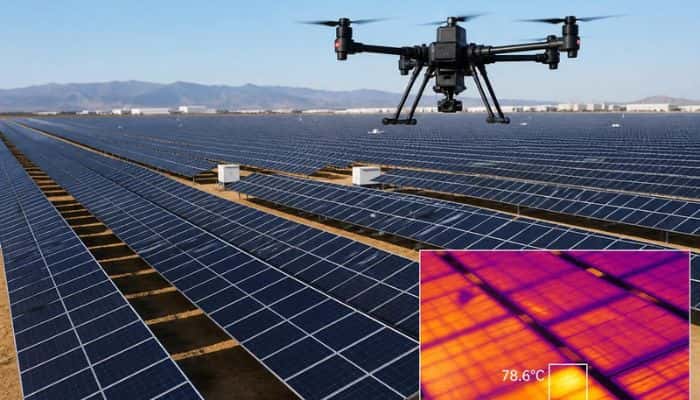
Even an advanced drone with thermal camera can produce inaccurate readings under unfavorable environmental conditions.
| Factor | Potential impact |
|---|---|
| Direct sunlight | Uneven surface heating |
| Rain | Temperature variations |
| High humidity | Atmospheric interference |
| Strong winds | Surface cooling |
| Shiny metal | Infrared reflections |
| Dense fog | Reduced detection capability |
| Excessive distance | Loss of image detail |
Surface emissivity and reflected infrared radiation significantly influence measurement accuracy. Professional thermography training helps operators identify these limitations and avoid misleading conclusions.
Thermal Drone Software and Inspection Workflow
Thermal imaging software helps professionals analyze temperature anomalies, process radiometric images, and generate inspection reports.
| Software | Primary purpose |
|---|---|
| DJI Thermal Analysis Tool | Radiometric analysis |
| FLIR Thermal Studio | Thermal reporting |
| DJI Terra | Compatible aerial mapping |
| Skydio thermal tools | Thermal visualization |
Professional Thermal Inspection Workflow
- Define inspection objectives and evaluate site conditions.
- Prepare equipment and configure measurement settings.
- Capture corresponding thermal and visual images.
- Analyze temperature anomalies and verify suspected defects.
- Document findings and recommended maintenance actions.
Always verify software compatibility with your drone’s radiometric file format before purchasing equipment.
Practical Example: Thermal Drone Solar Panel Inspection
A drone with thermal camera can help identify potential solar panel defects by comparing surface temperatures under similar operating conditions.
Consider the following hypothetical inspection:
| Solar panel | Temperature | Observation |
|---|---|---|
| Panel A | 42°C | Reference reading |
| Panel B | 43°C | Normal variation |
| Panel C | 64°C | Thermal anomaly |
| Panel D | 44°C | Normal variation |
Panel C appears 22°C warmer than the reference panel, indicating a potential issue. However, inspectors must evaluate shading, surface reflections, and environmental conditions before confirming a defect through electrical testing.
Advantages and Disadvantages of Thermal Imaging Drones
Thermal drones offer significant operational benefits but also have technical and financial limitations.
| Advantages | Disadvantages |
|---|---|
| Operate in complete darkness | High purchase costs |
| Detect temperature anomalies | Weather limitations |
| Reduce hazardous manual inspections | Specialized training |
| Cover large inspection areas | Limited battery life |
| Support preventive maintenance | Potential measurement errors |
| Provide detailed thermal data | Regulatory requirements |
Thermal cameras cannot directly see through solid walls, ordinary glass, soil, or dense vegetation.
Renting vs. Buying a Thermal Drone
Choosing between renting and buying a thermal drone depends on inspection frequency, budget, and long-term business requirements.
| Factor | Buying | Renting |
|---|---|---|
| Initial cost | Higher | Lower |
| Availability | Greater control | Booking dependent |
| Maintenance | Owner responsibility | Contract-dependent |
| Upgrades | Additional investment | Greater flexibility |
| Best for | Frequent inspections | Occasional projects |
Businesses conducting regular inspections may benefit from equipment ownership, while occasional users can reduce expenses by renting equipment or hiring qualified thermal inspection professionals.
Is Investing in a Thermal Drone Worth It?
Investing in a drone with thermal camera can be worthwhile for businesses conducting frequent inspections, reducing maintenance expenses, and improving operational efficiency.
Consider the following hypothetical investment example:
| Investment or savings | Amount |
|---|---|
| Drone purchase | $7,500 |
| Accessories | $1,000 |
| Training and software | $1,500 |
| Total investment | $10,000 |
| Monthly inspection savings | $1,250 |
| Monthly operating costs | $250 |
| Net monthly savings | $1,000 |
| Simple payback period | 10 months |
If monthly net savings decrease to $500, the payback period increases to 20 months.
Thermal drone ownership can offer long-term financial benefits for businesses with recurring inspection needs. However, actual returns depend on equipment utilization, maintenance expenses, operating costs, and business demand.
Common Mistakes When Buying Thermal Drones
Avoid these common purchasing errors:
- Confusing digital image enhancement with native resolution.
- Buying non-radiometric cameras for quantitative inspections.
- Assuming maximum flight endurance represents usable working time.
- Underestimating software, training, and maintenance expenses.
- Ignoring regional equipment authorization and aviation regulations.
- Treating thermal anomalies as confirmed equipment defects.
The best purchasing decision starts with defining the inspection problem rather than selecting the most expensive aircraft.
Legal and Safety Requirements for Thermal Drones
Operating a drone with thermal camera requires compliance with aviation, airspace, and applicable privacy regulations.
In the United States, most commercial small-drone operations fall under the FAA’s Part 107 regulations.
Requirements generally include remote pilot certification, aircraft registration, applicable Remote ID compliance, visual line of sight, and necessary airspace authorizations. Nighttime flights also have specific training and lighting requirements.
US buyers should consult the FCC Covered List for equipment authorization restrictions, particularly when considering newly introduced foreign-manufactured aircraft.
International buyers should consult their local aviation authorities and confirm regional equipment eligibility before purchasing.
Future of Thermal Imaging Drone Technology
Higher-resolution infrared sensors, automated inspection workflows, and artificial intelligence are expanding the capabilities of thermal drones.
Emerging applications include predictive maintenance, automated anomaly detection, and repeatable infrastructure assessments.
However, professional oversight remains essential. Automated systems must distinguish genuine equipment problems from environmental interference and measurement errors.
Conclusion
A drone with thermal camera can improve inspection efficiency, support preventive maintenance, and reduce some operational risks. However, its value depends on measurement reliability and the operator’s ability to interpret thermal data.
Choose a model based on actual inspection requirements, native sensor resolution, software compatibility, total ownership costs, and regulatory compliance rather than advertised specifications alone.
Drone With Thermal Camera FAQs
1. Can a drone with thermal camera detect gas leaks?
Yes, drones equipped with specialized optical gas imaging (OGI) sensors can detect certain gas leaks. Standard thermal cameras cannot reliably detect most gas leaks.
2. Can a drone with thermal camera record thermal videos?
Yes, many professional thermal drones support video recording. However, not all recorded thermal videos retain radiometric temperature measurement data.
3. Can a drone with thermal camera measure air temperature?
Standard thermal cameras primarily measure apparent surface temperatures rather than ambient air temperature. A separate temperature sensor is generally required.
Disclaimer
This article is for informational purposes only. Product specifications, prices, and availability may change. Always verify manufacturer information and applicable drone regulations before purchasing or operating thermal drones.
