
When people think about military drones, most imagine a flying machine circling overhead for a few hours. The real picture is far more impressive and far more varied. How Far Can a Military Drone Fly depends entirely on what type it is, what it is carrying, and what kind of power system drives it. A tiny drone strapped to a soldier’s vest might cover just a few kilometers. A high-altitude surveillance drone can circle the globe without landing.
In the modern battlefield, range is everything. A drone that can fly farther can watch more territory, strike deeper targets, and stay on mission longer without risking a human pilot. That is exactly why nations around the world invest billions of dollars in designing and buying long-range unmanned aerial vehicles (UAVs). Understanding how far military drones can fly also helps civilians, students, and policymakers grasp just how much drone technology has changed warfare in the 21st century.
This guide walks through every major category of military drone, from the palm-sized scouts used by foot soldiers to massive global reconnaissance platforms that travel halfway around the world without touching the ground. We will look at real specs, world records, the technology behind long-range flight, and how different countries compare. By the end, you will have a crystal-clear picture of what these machines can actually do and why it matters.
Military Drone Categories by Range
Not all military drones are built for long-distance travel. The military uses a broad spectrum of UAVs, each designed for a specific mission type. Before diving into exact numbers, it helps to understand the five main size and range categories that defense planners use worldwide.
1. Micro and Mini Drones (Close Range)
These are the smallest drones on the battlefield. Soldiers carry them in their backpacks and launch them by hand. Their primary job is giving troops eyes around the next corner or over the next hill. Range is typically under 5 kilometers, and flight time usually lasts 20 to 45 minutes.
Examples include the Black Hornet Nano, which fits in the palm of your hand and covers under 2 km, and the Raven RQ-11, a hand-launched drone used by the U.S. Army with a range of about 10 km. These drones run on small batteries and rely on direct radio links to the operator.
2. Close-Range Tactical Drones (10–150 km)
These are the workhorses of modern ground units. Battalion and brigade commanders use them to watch enemy positions, direct artillery fire, and track movement. Flight time stretches from 1 to 8 hours, and range covers 10 to 150 kilometers depending on the model.
3. Medium-Range Drones (150–650 km)
At this level, drones begin crossing into more serious operational territory. They can patrol wide frontline areas, support naval operations, and deliver strike capability at standoff distances. Flight time runs up to 12 hours in many cases.
4. MALE Drones Medium Altitude, Long Endurance (up to 1,850 km)
This is where the most famous military drones live. MALE drones like the MQ-9 Reaper fly at altitudes between 7,600 and 15,000 meters and can stay in the air for 24 to 27 hours at a stretch. They carry sensors, cameras, and weapons. Range reaches up to 1,850 km with satellite links.
5. HALE Drones High Altitude, Long Endurance (up to 22,800 km+)
HALE drones operate near the edge of the atmosphere, reaching altitudes above 18,000 meters. They are primarily used for intelligence gathering, communications relay, and strategic reconnaissance. The RQ-4 Global Hawk is the defining example, with a verified operational range of 22,800 km. Solar-powered HALE drones like the Zephyr go even further in terms of endurance, staying aloft for months.
| Category | Range | Altitude | Endurance | Primary Use |
| Micro / Mini | Under 5 km | Low (under 500 m) | 20–45 min | Squad-level recon |
| Close-Range Tactical | 10–150 km | Low-medium | 1–8 hours | Frontline surveillance |
| Medium-Range | 150–650 km | Medium | 8–16 hours | Area patrol, strike support |
| MALE (MQ-9 Reaper class) | Up to 1,850 km | 7,600–15,000 m | 24–27 hours | ISR + precision strike |
| HALE (RQ-4 Global Hawk class) | Up to 22,800 km | 18,000+ m | 30–34 hours | Strategic surveillance |
| Solar HALE (Zephyr class) | Virtually unlimited | 21,000+ m | Days to months | Pseudo-satellite ISR |
Top Military Drones and Their Exact Ranges
Let us look at the most important military drones in service today and the real numbers behind their flight capabilities. These are not estimates; these are verified specifications from official sources, defense organizations, and academic research.
MQ-9 Reaper (United States)
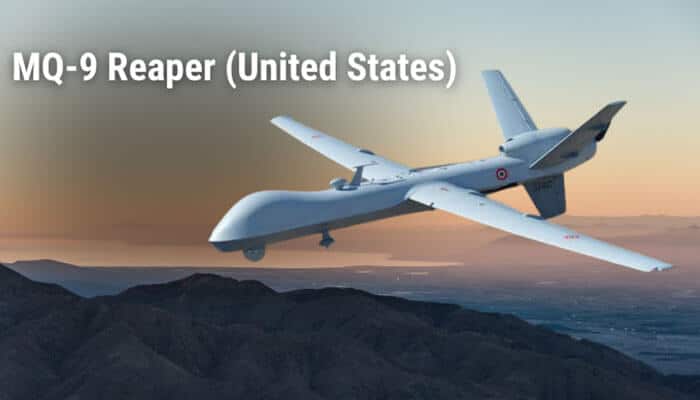
The MQ-9 Reaper is probably the most recognized military drone in the world. Built by General Atomics, it was first deployed over Afghanistan in 2008 and has since become the backbone of American remotely piloted aircraft operations. The Reaper is a MALE-class drone designed for both surveillance and precision strike missions.
- Operational Range: 1,850 km (approximately 1,150 miles)
- Maximum Altitude: 15,240 meters (50,000 feet)
- Endurance: Up to 27 hours (extended variants up to 42 hours with drop tanks)
- Wingspan: 1 meters
- Payload: Up to 1,700 kg, including Hellfire missiles and laser-guided bombs
- Engine:900 hp Honeywell turboprop
- Cost: Approximately $30–33 million per unit
What gives the Reaper its long reach is its satellite communication system. Rather than relying on ground-based radio (which limits range to line-of-sight), the Reaper connects to satellites, allowing operators in the United States to fly missions happening in Africa or the Middle East in real time.
RQ-4 Global Hawk (United States)
If the Reaper is built to hunt, the Global Hawk is built to watch from very far away, for a very long time. Built by Northrop Grumman, the RQ-4 is the gold standard of strategic surveillance drones.
- Operational Range: 22,800 km, the longest of any production military drone
- Maximum Altitude: 18,288 meters (60,000+ feet)
- Endurance: Up to 34 hours per sortie
- Wingspan: 9 meters (roughly the size of a Boeing 737)
- Speed: Up to 629 km/h cruise speed
- Cost: Approximately $131 million per unit
To put 22,800 km in perspective, that is roughly the distance from New York to Sydney and back. A single Global Hawk can cover an area the size of South Korea in just 24 hours of flight.
Bayraktar TB2 (Turkey)
The TB2 became a household name after its effectiveness in the Libya, Nagorno-Karabakh, and Ukraine conflicts. It is a MALE-class drone built by Baykar Defense and has proven that smaller, cheaper drones can change battlefield outcomes dramatically.
- Operational Range: Up to 150 km from ground station
- Maximum Altitude: 7,620 meters
- Endurance: Up to 27 hours
- Cost: Approximately $1–5 million per unit (far cheaper than US equivalents)
CH-5 Rainbow (China)
China’s CASC CH-5 Rainbow is its most capable MALE-class drone and represents the country’s growing drone export ambitions.
- Operational Range: Over 10,000 km
- Endurance: Up to 60 hours
- Maximum Altitude: 10,000 meters
Heron TP (Israel)
Israel Aerospace Industries’ Heron TP is one of the most capable MALE-class drones outside the United States. It is used by Israel and exported to several allied nations.
- Operational Range: Over 7,000 km
- Endurance: Up to 36 hours
- Maximum Altitude: 13,700 meters
Did You Know?
The MQ-9 Reaper costs about $3,624 per flight hour to operate expensive by civilian standards, but roughly 10 times cheaper than flying an F-16 fighter jet on a similar mission. That cost advantage is a major reason militaries worldwide keep expanding their drone fleets.
| Drone | Country | Range | Endurance | Role |
| MQ-9 Reaper | USA | 1,850 km | 27–42 hrs | ISR + Strike |
| RQ-4 Global Hawk | USA | 22,800 km | 34 hrs | Strategic ISR |
| Bayraktar TB2 | Turkey | 150 km | 27 hrs | Tactical Strike |
| CH-5 Rainbow | China | 10,000+ km | 60 hrs | ISR + Strike |
| Heron TP | Israel | 7,000+ km | 36 hrs | Multi-mission ISR |
| WB-57 (modified) | USA (NASA/USAF) | ~6,700 km | 8 hrs | Research/ISR |
| RQ-170 Sentinel | USA | Classified | Classified | Stealth ISR |
| Airbus Zephyr S | UK/USA | Virtually unlimited | 64+ days | HAPS / Pseudo-satellite |
World Records: How Far Has a Military Drone Actually Flown?
Official specifications tell one story. Real-world flight records tell another, often more dramatic one. Here are the most important milestones in military drone range and endurance history.
The Airbus Zephyr 64 Days and Nearly 35,000 Miles
The most extraordinary endurance record in drone aviation history belongs to the Airbus Zephyr 8, a solar-powered unmanned aircraft tested by the U.S. Army. On June 15, 2022, it took off from Yuma Proving Ground in Arizona. It finally came down due to an anomaly on August 18, 2022. That is 64 days of continuous flight, covering almost 35,000 miles (56,000 km) without a single refueling stop.
During its record-setting flight, the Zephyr crossed airspace over the southern United States, the Gulf of Mexico, and parts of South America. It flew at altitudes around 70,000 feet, well above commercial airline traffic and most weather systems. The drone weighs just 165 pounds despite having an 82-foot wingspan, made possible by ultralight carbon fiber construction. During the day, thin solar panels on its wings charged lithium-ion batteries. At night, those batteries powered its propellers.
Record Summary: Airbus Zephyr 8 64 days, ~35,000 miles (56,000 km) continuous flight U.S. Army test, Yuma Proving Ground, 2022. This is the longest recorded drone flight in history and nearly the longest recorded flight by any aircraft ever built.
RQ-4 Global Hawk First Autonomous Transatlantic Drone Flight
In April 2001, a Global Hawk completed the first-ever transatlantic flight by an unmanned aircraft, flying from Edwards Air Force Base in California to RAAF Base Edinburgh in South Australia, a journey of roughly 22,000 km in just over 22 hours. This flight demonstrated that drones were no longer confined to short-range missions.
MQ-9 Reaper 42-Hour Extended Mission
Under special configuration with drop tanks and reduced weapons load, the MQ-9 Reaper has demonstrated a flight endurance of approximately 42 hours, enough to fly from Washington D.C. across the Atlantic, conduct a full surveillance mission over a target zone, and return without refueling.
What Determines How Far a Military Drone Can Fly?
When people ask how far a military drone can fly, they are really asking about a combination of engineering decisions, mission requirements, and physics. Here is a plain-language breakdown of the key factors.
1. Power Source and Fuel Type
This is the single biggest driver of range. Military drones use three main types of power:
- Turboprop engines (like the MQ-9): These run on aviation fuel and provide high power output. They can sustain long missions but are limited by fuel tank size and weight.
- Turbofan/jet engines (like the Global Hawk): More fuel-efficient at high altitudes. The Global Hawk uses a Rolls-Royce AE 3007H turbofan that allows it to cruise at high speed for enormous distances.
- Solar electric (like the Zephyr): During daylight hours, solar cells charge batteries. This allows theoretically unlimited endurance as long as the drone keeps flying and the sun keeps shining. The tradeoff is very low payload capacity and sensitivity to weather.
2. Altitude
Higher altitude means thinner air, which reduces drag and allows more efficient cruising. HALE drones fly above 60,000 feet specifically because the air up there offers far less resistance than at lower altitudes. However, flying high also means the drone needs more powerful sensors to see the ground below.
3. Payload Weight
Every pound of weapons, sensors, or cameras added to a drone reduces its range. The MQ-9 Reaper carrying a full load of Hellfire missiles and cameras flies a different mission profile than one launched purely for surveillance with empty weapon stations. Military planners constantly balance firepower versus endurance on each sortie.
4. Communication and Control Links
A drone can have unlimited fuel but still be unable to fly far if its control signal cannot reach it. This is where satellite communication becomes critical. Line-of-sight radio links max out at roughly 150–200 km depending on terrain. Satellite-linked drones like the Reaper and Global Hawk can be flown by operators sitting in Nevada while the drone itself is circling over Iraq or Somalia, a distance of over 10,000 km from the control station.
5. Airframe and Wing Design
Fixed-wing drones fly much farther than multi-rotor drones. A multi-rotor design wastes enormous energy just staying aloft; every rotor is fighting gravity constantly. A fixed-wing design, like a glider or airplane, uses the lift of its wings to stay up with relatively little power. All long-range military drones are fixed-wing for exactly this reason.
6. Weather and Atmospheric Conditions
Headwinds reduce effective range. Tailwinds extend it. Turbulence forces drones to consume more energy maintaining stability. Icing at high altitudes can damage delicate surfaces. Military mission planners factor weather forecasts into every long-range sortie, sometimes changing routes or timing to minimize atmospheric resistance.
Key Insight: The difference between a military drone that can fly 150 km and one that can fly 22,800 km is not just engine power, it is the combination of satellite uplinks, high-efficiency airframe design, fuel-optimized altitude, and smart mission planning all working together.
How Different Countries Compare in Military Drone Range
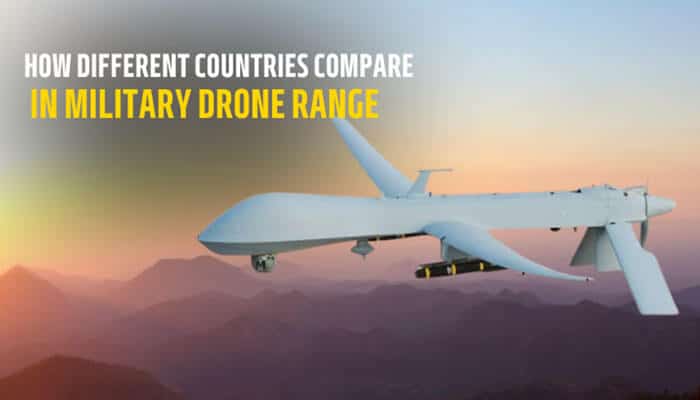
Understanding how far military drones can fly around the world also means understanding which countries have invested most in this technology and which are catching up fast.
United States: The Undisputed Leader
The U.S. operates the widest range of military UAVs at every capability level. From the tiny Black Hornet nano-drone to the global-range RQ-4 Global Hawk, American military drones cover the full spectrum. The Pentagon’s investment in drone technology has been consistent for over 25 years, giving American forces unmatched drone depth and operational experience.
China Fast Riser with Global Ambitions
China’s CASC CH series drones have made rapid progress. The CH-5 Rainbow boasts an endurance of 60 hours and a range exceeding 10,000 km. China is also aggressively exporting drones to countries in Africa, the Middle East, and Asia that cannot afford U.S. equipment, reshaping the global drone market dramatically.
Israel, a Small Country, Big Capability
Israel Aerospace Industries (IAI) and Elbit Systems produce some of the world’s most battle-proven drones. The Heron TP’s 36-hour endurance and 7,000+ km range rival anything not built in the United States. Israeli drone technology is widely exported to NATO allies and other partners.
Turkey Disruptive Force in Mid-Range Drones
The Bayraktar TB2’s combat record in multiple conflicts has made Turkey a major force in the drone export market. While the TB2’s 150 km range is modest by HALE standards, its proven effectiveness in real wars and low price tag make it enormously influential.
Iran Asymmetric Drone Power
Iran has developed a range of domestically produced drones, including the Shahed-136, used extensively as a loitering munition in the Russia-Ukraine conflict. These are not long-range surveillance drones but rather relatively cheap one-way attack drones with ranges of roughly 2,000+ km. They represent a different kind of drone range capability reach without recovery.
| Country | Top Drone | Max Range | Global Reach Level |
| 🇺🇸 United States | RQ-4 Global Hawk | 22,800 km | ⭐⭐⭐⭐⭐ Global |
| 🇨🇳 China | CH-5 Rainbow | 10,000+ km | ⭐⭐⭐⭐ Near-Global |
| 🇮🇱 Israel | Heron TP | 7,000+ km | ⭐⭐⭐⭐ Regional+ |
| 🇬🇧 United Kingdom | Protector RG Mk1 | 6,000+ km | ⭐⭐⭐ Regional |
| 🇹🇷 Turkey | Bayraktar Akıncı | ~5,000 km | ⭐⭐⭐ Regional |
| 🇮🇷 Iran | Shahed-136 | ~2,000 km | ⭐⭐ Sub-Regional |
| 🇮🇳 India | MQ-9B (acquired) | 1,850 km | ⭐⭐ Sub-Regional |
The Role of Satellite Communication in Military Drone Range
This is one of the most important and least discussed factors behind how far military drones can fly. Without satellite links, even the most advanced military drone is limited to the reach of its radio signal from the ground station, typically 100–200 km over flat terrain.
Satellite communication changed everything. Here is how it works in simple terms:
- The drone takes off from a base in, say, Italy.
- Once airborne, it establishes a communications link with a military satellite orbiting at high altitude.
- That satellite relays signals to a ground control station that might be located thousands of kilometers away in the U.S., the U.K., or any allied nation.
- The pilot and sensor operators at that distant station can now fly the drone, view its camera feeds, and fire its weapons all in near-real time with only a brief signal delay.
This is not science fiction. It has been standard practice for the MQ-9 Reaper and RQ-4 Global Hawk since the early 2000s. The drone’s physical range is only limited by fuel, not by the distance to the operator. As long as satellite coverage exists and fuel holds, the drone can go anywhere.
The military categorizes this as BLOS Beyond Line Of Sight control as opposed to the direct radio links used by smaller tactical drones. BLOS capability is the threshold that separates regional drones from truly global ones. It is also why acquiring satellite communication architecture is just as strategically important as acquiring the drones themselves.
The Future of Military Drone Range
Where the military drone range goes from here is one of the most closely watched questions in defense technology. Several trends are already shaping what the next generation of drones will be capable of.
Hydrogen Fuel Cell Drones
Hydrogen fuel cells produce electricity through a chemical reaction with almost zero heat signature and no exhaust. Several defense programs are actively developing hydrogen-powered drones with endurance goals of 80 to 100 hours, far surpassing conventional turboprops. The low heat signature also makes them harder for enemy sensors to detect.
Solar-Electric HAPS (High Altitude Platform Stations)
The Zephyr’s 64-day flight proved that solar-powered drones can stay aloft indefinitely in theory. Future HAPS platforms are being designed to carry much heavier communications and surveillance payloads while maintaining months-long endurance. Companies like Airbus, Boeing (with its Phantom Eye concept), and startup firms are all pursuing this space.
AI-Controlled Autonomous Long-Range Drones
The next step beyond satellite-linked remote control is full autonomy. Drones that can plan their own routes, identify targets, make navigation decisions, and return home without any human input during flight. This removes the communication link as a range limitation entirely. Several classified U.S. and allied programs are believed to be testing various degrees of autonomous flight for long-range UAVs.
Loyal Wingman / Combat Air Teaming
Programs like Boeing’s MQ-28 Ghost Bat (Australia) and the USAF’s Collaborative Combat Aircraft (CCA) program pair unmanned drones with manned fighter jets. These drones fly in formation with crewed aircraft, extending the team’s reach, absorbing risk, and carrying additional sensors or weapons. The drone’s effective range becomes the combined range of the manned-unmanned team.
Swarm Technology
Rather than sending one large, expensive drone deep into enemy territory, swarm concepts involve deploying hundreds of small, relatively cheap drones. Each individual drone has limited range, but the swarm as a collective covers enormous distances and presents a far harder target for enemy defenses to address.
Final Thoughts
The question of how far a military drone can fly does not have a single answer; it has a spectrum. At one end sits a soldier’s nano-drone that fits in a shirt pocket and covers 2 km. At the other end sits a solar-powered stratospheric aircraft that once flew for 64 consecutive days across two continents. Between those extremes lies a rich and rapidly evolving technology landscape that is reshaping how wars are fought, how borders are watched, and how nations project power without risking human lives.
What the numbers make clear is this: range in military drones is no longer a barrier. Satellite communication, solar power, efficient airframes, and decades of operational refinement have taken military drones from short-range curiosities into tools that can reach any point on Earth. The limits that remain are political, legal, and ethical, not engineering ones.
For anyone trying to understand modern warfare, drone range is one of the most important numbers to know. It is the difference between a weapon that protects a hilltop and one that can watch an entire continent without ever landing.
How Far Can a Military Drone Fly FAQ’s
1. How far can a military drone fly on a single mission?
Military drone range depends on class, from a few kilometers for small tactical UAVs to over 20,000 km for high-altitude systems. For example, the MQ-9 Reaper reaches about 1,850 km, while the RQ-4 Global Hawk exceeds 22,000 km.
2. Can military drones fly across the ocean?
Yes, high-altitude long-endurance (HALE) drones can cross oceans using satellite communication links for control. The RQ-4 Global Hawk demonstrated trans-Pacific capability, proving intercontinental unmanned flight is operationally feasible.
3. What limits how far a military drone can fly?
The main limits are fuel capacity, payload weight, aerodynamic efficiency, weather, and airspace restrictions. For satellite-linked systems like the MQ-9 Reaper, fuel is usually the primary constraint rather than communication range.
4. Which military drone has the longest range in the world?
The RQ-4 Global Hawk is widely cited for having one of the longest operational ranges at over 22,000 km. However, solar-powered platforms like the Airbus Zephyr can achieve extreme endurance and record-breaking total flight distances.
5. How does the MQ-9 Reaper communicate when flying far from its base?
The MQ-9 Reaper uses satellite communication links to stay connected with operators thousands of kilometers away. This allows pilots to control it in near real time with only minimal signal delay.
6. How high do military drones fly?
Military drones fly at different heights. Small tactical drones usually stay below 5,000 m, MQ-9 Reaper drones reach about 15,000 m, and HALE drones like Global Hawk can fly above 18,000 m.
7. What is the difference between range and endurance for military drones?
Range is how far a military drone can travel. Endurance is how long it can stay in the air. Range measures distance, while endurance measures flight time.
8. What is the difference between range and endurance for military drones?