
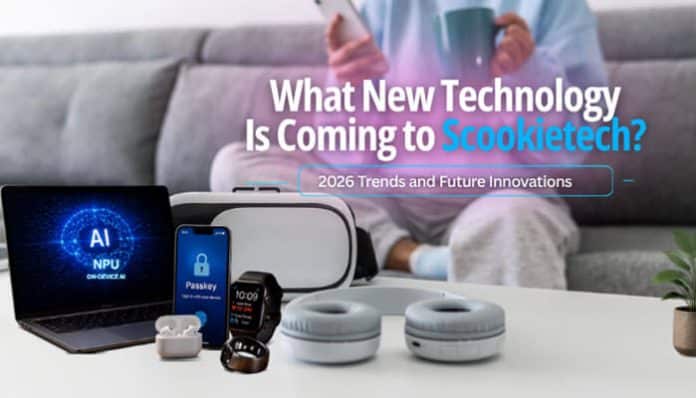
Every few months, a new gadget or app shows up, and suddenly everyone is talking about it. Then six months later, nobody remembers it. That’s how most tech news feels: A lot of noise, not much that actually sticks. If you’ve been asking what new technology is coming to scookietech, you’re really asking a simpler question underneath: Which of these changes are actually going to affect my daily life, and which ones are just hype dressed up as a headline?
This guide is built to answer that question honestly. Instead of listing buzzwords, it breaks down the technology that is genuinely rolling out in 2026 the kind you can already buy, already use, or will be using within the next year. Every section below covers what new technology is coming to scookietech readers by explaining not just what a technology is, but why it matters and who it actually helps.
By the end, you’ll have a clear picture of where things stand: What’s real, what’s still mostly marketing, and what’s worth paying attention to. No filler, no vague promises, just a straight breakdown of the technology shaping 2026.
Why 2026 Feels Different From Previous Tech Years
Tech coverage has a habit of overselling everything. But 2026 has a few genuine turning points behind it, which is part of why so many people are searching for what new technology is coming to scookietech right now:
- AI has moved from “chatbot in a browser tab” to hardware built specifically to run it, meaning it’s faster, cheaper, and works even without an internet connection.
- Smart home devices from different brands finally talk to each other properly, after years of incompatible apps and standards.
- Wearables have quietly gained medical-grade sensors that used to require a doctor’s office visit.
- Software development tools have gotten dramatically faster at turning ideas into working products.
None of this is science fiction. It’s already shipping. Here’s the breakdown.
AI-Ready Hardware: Neural Processing Units (NPUs)
For the last two years, “AI” mostly meant sending your data to a company’s server and waiting for a reply. That’s changing fast.
New laptops and phones in 2026 increasingly ship with a Neural Processing Unit (NPU), a chip built specifically to run AI tasks directly on your device, instead of a distant server.
Why this matters:
| Old way (cloud AI) | New way (on-device AI with NPU) |
| Needs internet connection | Works offline |
| Sends your data elsewhere | Keeps data on your device |
| Can feel slow (network delay) | Responds instantly |
| Costs the company money per use | Runs “free” once you own the hardware |
This is a genuine answer to what new technology is coming to scookietech in the hardware space: it’s not a new gadget, it’s a redesign of the chips inside the gadgets you already use.
Smart Homes That Finally Work Together: The Matter Protocol

If you’ve ever bought a smart lock from one company, a thermostat from another, and a light bulb from a third, you already know the pain. Three apps. Three logins. Devices that won’t talk to each other.
Matter is the industry-wide standard designed to fix exactly this. It’s a shared language that lets devices from different brands work together without extra setup.
What’s actually changed in 2026:
- Locks from brands like Schlage and August now connect directly with thermostats like Ecobee no bridge device needed.
- Lighting, locks, and climate control can be managed from a single app, regardless of manufacturer.
- Prices have dropped as more manufacturers adopt the standard, since compatibility used to be a premium feature.
This is one of the clearest, most practical answers to what new technology is coming to scookietech for anyone setting up a home: Less app-juggling, more things that just work.
Wearables That Actually Monitor Your Health
Fitness trackers used to count steps and call it a day. That’s no longer the ceiling.
Devices like the Oura Ring and newer smartwatches now include sensors capable of tracking blood pressure trends without a separate cuff, along with more advanced readings like:
- Heart rate variability (a signal of stress and recovery)
- Blood oxygen levels
- Sleep stage tracking (not just duration, but sleep quality)
These are trend-tracking tools, not medical diagnostic devices. They’re useful for noticing patterns over time, but they don’t replace a doctor’s equipment or a proper check-up. Still, for people who’d otherwise never check these numbers at all, it’s a meaningful shift and a major part of what new technology is coming to scookietech in personal health.
Faster Software Development: WebAssembly and AI Coding Tools
This one is less visible to everyday users but affects almost everything you use online.
WebAssembly (WASM) is a technology that lets code run at near-native speed inside a web browser. In 2026, it’s moved well beyond browser games; WASM is now used for serious business software, letting companies build powerful tools that used to require a full desktop app.
At the same time, AI-assisted coding tools have gotten noticeably better at understanding an entire codebase’s context, not just the single line being written. This means developers ship features faster and spend less time on repetitive, boilerplate work.
You won’t “see” this technology directly, but you’ll feel it: apps and websites that used to feel slow or clunky are increasingly snappy, and new features arrive faster than they used to.
Spatial Computing: AR and Mixed-Reality Headsets
For years, “AR glasses” were a promise that never quite arrived. That’s shifted in 2026.
Mixed-reality headsets have moved from a niche developer toy into something closer to a real productivity and entertainment device. Instead of a flat screen, these devices let you place windows, videos, and apps in the physical space around you: A virtual monitor floating over your desk, or a video call that feels like the other person is sitting across the table.
What’s changed to make this practical instead of gimmicky:
- Lighter headsets with better battery life, closing the gap between “wearable” and “exhausting to wear.”
- Improved hand and eye tracking, so you control things by looking and pinching instead of holding a separate controller.
- Business use cases: Remote collaboration, design review, training simulation are now common enough that this counts as a legitimate answer to what new technology is coming to scookietech for workplaces, not just gamers.
It’s still an expensive category, and it won’t replace your laptop or phone yet. But it’s no longer just a demo; people are genuinely using it for daily work.
Passwordless Login: Passkeys Are Replacing Passwords

Here’s a change that’s less flashy but arguably more useful to more people than anything else on this list: passwords are quietly disappearing.
Passkeys let you log into accounts using your fingerprint, face scan, or device PIN instead of typing a password. Under the hood, they use a security method that’s much harder to steal or phish than a traditional password, because there’s no password sitting on a server for hackers to leak in the first place.
Why this matters for everyday people:
- No more forgetting passwords or reusing the same weak one everywhere.
- Far more resistant to phishing scams, since there’s nothing to “trick” you into typing.
- Major platforms, banking apps, email providers, and social media have been rolling this out broadly through 2025 and 2026, so most people will encounter it whether they seek it out or not.
If you’ve noticed your phone or laptop offering to sign in with your fingerprint instead of a password, that’s this technology in action. It’s a quiet answer to what new technology is coming to scookietech in the security space, but a meaningful one.
Faster-Charging, Longer-Range EV Batteries
Electric vehicles have been around for a while, but the batteries powering them have taken a real step forward in 2026.
Newer battery chemistries and charging systems have pushed two numbers in the right direction at once something that used to be a trade-off:
- Charging speed: some newer EV platforms can add well over 100 miles of range in around 10-15 minutes at a fast charger, closing the gap with a traditional gas station stop.
- Range: improved battery density means more miles per charge without a larger, heavier battery pack.
- Cost: as production scales up, battery costs continue to drop, which is gradually bringing EV prices closer to equivalent gas-powered vehicles.
This matters beyond just car buyers; the same battery technology improvements are trickling into home energy storage and even some consumer electronics, making it one of the broader, quieter shifts covered under what new technology is coming to scookietech.
A Quick Comparison: 2024 vs. 2026 Technology Baseline
| Category | Typical in 2024 | Typical in 2026 |
| AI processing | Cloud-only | On-device NPU + cloud hybrid |
| Smart home | Fragmented, brand-locked | Matter-standard, cross-brand |
| Wearables | Step count, heart rate | Blood pressure trends, sleep staging |
| App performance | Native app often required | Browser-based apps near-native speed |
| Software development | Manual, slower iteration | AI-assisted, faster shipping |
What’s Still Mostly Hype
Not everything labeled “the future of tech” is actually ready. A few things worth being skeptical about in 2026:
- Fully autonomous personal AI agents: Tools that supposedly handle your whole schedule end-to-end are still unreliable for anything beyond simple tasks.
- Consumer brain-computer interfaces: Still experimental, mostly limited to medical research settings, not ready for general use.
- Widespread quantum computing: Real and advancing, but not something that affects everyday consumer technology yet.
Being able to tell these apart from the real, working technology above is exactly the point of understanding what new technology is coming to scookietech, separating what’s shipping from what’s still just a demo.
Final Thoughts
Technology headlines move fast, but real, usable progress moves a little slower, and that’s a good thing. What new technology is coming to scookietech boils down to a handful of solid, practical improvements: AI that runs on your own device, a smart home that finally behaves, wearables that catch health patterns early, and software that ships faster than ever. None of it requires waiting for some distant future. It’s already here, and it’s worth paying attention to.
What New Technology Is Coming to Scookietech FAQs
1. What does “what new technology is coming to Scookietech” actually mean?
It refers to the practical, real-world technology trends rolling out in 2026: the tools, devices, and standards that are genuinely available now or arriving soon, rather than distant concepts.
2. Is on-device AI (NPU) actually better than cloud AI?
For privacy and speed, yes, it keeps data local and responds faster. For very large, complex tasks, cloud AI still has more raw power. Most 2026 devices use a mix of both.
3. Do I need to replace all my smart home devices to use Matter?
No. Many existing devices are getting Matter support through software updates. New purchases are increasingly Matter-certified by default, which makes future upgrades easier too.
4. Can wearables replace a doctor’s blood pressure check?
No. They’re helpful for spotting trends over time, but they aren’t certified medical diagnostic tools. Always confirm important readings with an actual healthcare provider.
5. What’s the most practical technology to pay attention to right now?
For most people, Matter-based smart home devices and NPU-equipped laptops or phones offer the most immediate, noticeable everyday benefit.