
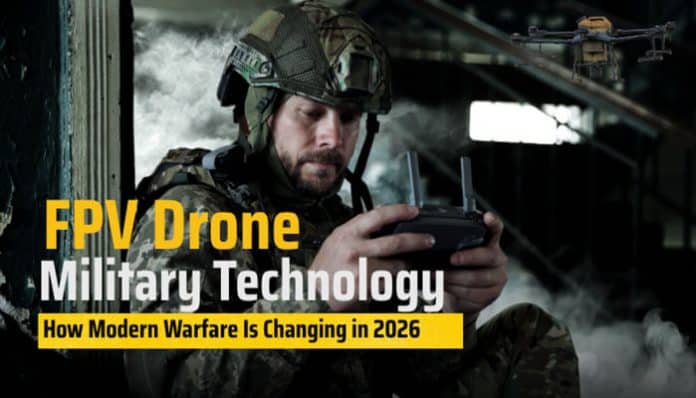
War doesn’t look the way it used to. For most of history, the side with bigger tanks, more soldiers, and stronger armor usually won. That’s no longer the full story. Today, a drone that costs less than a smartphone can destroy a tank worth millions of dollars. This is the reality of FPV drone military technology in 2026, and it’s rewriting the rules of combat faster than most militaries can keep up.
FPV stands for “first-person view.” It means the person flying the drone sees exactly what the drone sees, through a live video feed sent to goggles or a screen, as if they were sitting inside the cockpit. Pilots first used this technology for racing and stunt videos. Now, it’s one of the most talked-about weapons on modern battlefields, from Ukraine’s front lines to NATO training grounds in the Arctic Circle.
This article breaks down what FPV drone military technology actually is, why it has become so important in 2026, how it’s changing tactics for soldiers and generals alike, and what the future might hold. Whether you’re a student, a defense enthusiast, or just someone curious about the headlines, this guide will walk you through it in plain, simple language.
What Is an FPV Military Drone?
An FPV military drone is a small, remote-controlled aircraft, usually with four propellers, that carries a camera and often an explosive charge. The operator wears video goggles and flies the drone by sight, guiding it directly into a target such as a vehicle, a building, or enemy soldiers.
Unlike the large, expensive military drones you might picture (like the American Reaper, which can cost over $30 million), a basic FPV combat drone can be built for a few hundred dollars using parts that are available commercially. That price difference is the whole reason this technology has taken over modern warfare so quickly.
Key features of an FPV military drone:
- Small size, usually light enough to carry in a backpack
- Live video feed sent to the pilot’s goggles in real time
- High speed and quick, sharp turns, much faster than typical surveillance drones
- Low production cost, often assembled from off-the-shelf parts
- Usually a one-way, single-use weapon rather than a reusable aircraft
- Can be modified to carry small explosives, grenades, or anti-tank warheads
Why FPV Drone Military Technology Exploded in 2026
A few years ago, FPV drones were a niche tool used by a handful of forces. Now they are a core part of how armies fight. Several things pushed FPV drone military technology into the mainstream.
1. The Cost-to-Damage Ratio Is Unmatched
This is the single biggest reason for the shift. A basic FPV attack drone can cost around $500. A modern main battle tank can cost around $5 million. When a $500 weapon can disable a $5 million machine, that’s a cost-exchange ratio that no army can ignore. Analysts have compared this shift in warfare economics to the historical jump from cavalry charges to rifled muskets in the 1850s, a moment that permanently changed how battles were fought.
2. Mass Production Changed the Battlefield Math
Ukraine went from producing zero FPV drones domestically in early 2022 to manufacturing around 150,000 units per month by late 2025. Plans for 2026 involve scaling toward supplying millions of these drones to front-line units over the year. When one side can flood a battlefield with thousands of cheap, expendable drones, it changes how ground troops move, hide, and fight. Whoever saturates an area with drones first often sets the pace of the entire battle.
3. Fiber-Optic Cables Solved the Jamming Problem
For years, the best defense against FPV drones was electronic warfare, jamming the radio signal that connects the drone to its pilot. That worked well for a while. Then engineers attached spools of hair-thin fiber-optic cable to the drones instead of relying on radio signals.
Because the drone is connected to the pilot through a physical cable instead of a wireless signal, there is no radio frequency to jam. This makes fiber-optic FPV drones almost completely resistant to traditional electronic warfare. Some fiber-optic systems have already demonstrated ranges of 50 kilometers, letting operators strike deep behind enemy lines and disrupt supply routes that used to be considered safe.
4. AI Is Making the Drones Smarter
Newer FPV systems are starting to include artificial intelligence that can lock onto a target and guide the drone in during the final stretch of flight, even if the video or control signal drops. Reports suggest that AI-assisted targeting has helped raise strike success rates dramatically compared to early manually piloted drones. This means the human pilot handles the early flight and navigation, while the drone’s own software finishes the job with precision.
How FPV Drones Are Changing Military Tactics
The rise of FPV drone military technology hasn’t just added a new weapon to the battlefield. It has changed how soldiers move, plan, and survive. Here’s a breakdown of the biggest tactical shifts.
Soldiers Now Fight Under Constant Watch
Because FPV drones are cheap and easy to launch, front-line troops are almost always at risk of being spotted and targeted. This has pushed soldiers to change how they move, often crawling, using tree cover, or moving only at night to avoid drone cameras overhead.
Vehicles Are More Vulnerable Than Ever
Tanks and armored vehicles used to be a battlefield’s strongest asset. Now, engineers are adding cage-like armor, called “cope cages,” over vehicles specifically to block or deflect FPV drone strikes. Some military forces are even redesigning next-generation tanks with drone warfare in mind from the start.
Logistics and Supply Lines Are Now Battlefronts
Long-range fiber-optic FPV drones can now strike supply trucks, fuel convoys, and resupply routes far from the actual front line. This has forced militaries to rethink how and when they move supplies, sometimes creating serious logistics slowdowns for the side under threat.
New Military Units Are Being Built Around Drones
Entire specialized drone units have been created just to handle FPV operations, both for attacking and for defending against enemy drones. These units are increasingly seen as central to holding a front line, not a support role on the side.
The Rise of Counter-FPV Drone Technology
Where there’s a new weapon, there’s usually a new defense being built to stop it. As FPV drone military technology has spread, so has an entire industry built around countering it.
Common counter-drone methods being developed and tested in 2026:
- Kinetic interceptor drones: Drones designed to physically ram and knock enemy FPV drones out of the sky using onboard targeting software
- High-power microwave weapons: Systems capable of disabling a drone’s electronics, including fiber-optic guided drones that can’t be jammed through normal means
- Shotgun and net-based defenses: Simple, low-cost tools that infantry can use for last-line defense against incoming drones at close range
- Dedicated counter-drone units: Trained teams whose entire job is detecting, tracking, and neutralizing enemy drones before they reach a target
- Modular defense systems: Equipment that can be mounted on vehicles or fixed positions, built to NATO standards for wider deployment
This back-and-forth between drone attacks and drone defenses has become one of the fastest-moving areas of military technology. What works today may be outdated within months, forcing constant innovation on both sides.
Which Countries Are Leading FPV Drone Military Development?
FPV drone military technology is no longer limited to one conflict or one region. It has spread globally.
- Ukraine has become one of the most advanced FPV drone producers in the world out of pure necessity, scaling from no domestic production to hundreds of thousands of units per month.
- Russia has developed long-range fiber-optic drones capable of striking deep behind enemy lines, targeting logistics and supply routes.
- The United States is testing fiber-optic FPV systems through the Marine Corps and Army, alongside interceptor drones designed to hunt other drones, as part of programs aimed at rapidly modernizing its arsenal.
- NATO members, including Norway, are testing FPV drones in extreme cold-weather conditions as part of Arctic defense exercises, exploring how this technology performs outside of typical battlefield environments.
- China has been rapidly expanding its own military drone fleet, with reported goals of significantly scaling up numbers by the end of the decade.
- Non-state groups have also gained access to FPV drone technology, including documented cases of small drones being used to down helicopters, showing how far this technology has spread beyond traditional militaries.
Limitations of FPV Drone Military Technology
Despite all the attention, FPV drones aren’t a perfect weapon, and it’s worth understanding where they fall short.
- Short range on standard models: Many radio-controlled FPV drones only work effectively within a few kilometers unless fitted with fiber-optic cables or signal boosters
- Vulnerable to jamming: Standard radio-frequency drones remain an easy target for electronic warfare, unless upgraded with fiber-optic control
- Single-use design: Most attack FPV drones are not reusable, so lost drones directly translate into lost investment
- Weather sensitivity: Wind, snow, and rain can affect flight stability and camera visibility
- Requires skilled pilots: Flying an FPV drone precisely enough to strike a moving or small target takes real training and practice
- Limited against heavily defended targets: Compared to cruise missiles or larger precision weapons, FPV drones generally carry less destructive payload
What’s Next for FPV Drone Military Technology?
Looking ahead, a few trends are likely to define how FPV drone military systems continue to evolve:
1. Wider adoption of fiber-optic control to defeat electronic jamming, especially for high-value, long-range strikes.
2. More AI-assisted targeting, reducing how much skill a human pilot needs while increasing strike accuracy.
3. Dual-mode drones that can switch between radio and fiber-optic control if a cable snaps mid-flight, a solution already being tested by engineers on the ground.
4. Larger investment in counter-drone systems, as militaries realize that defending against cheap drones is now just as important as building them.
5. Broader global adoption, as more countries and even non-state groups gain access to low-cost drone technology.
Final Thoughts
FPV drone military technology has moved from a niche experiment to one of the defining tools of modern warfare in just a few years. It has changed how soldiers move, how vehicles are designed, how supply lines are protected, and how much a country needs to spend to build real battlefield power. A $500 drone forcing a rethink of $5 million tanks isn’t a small shift, it’s a fundamental one.
As fiber-optic control, AI targeting, and counter-drone defenses continue to develop side by side, one thing is clear: this technology isn’t a passing trend. It’s becoming a permanent part of how wars are planned, fought, and eventually, defended against.
FPV Drone Military FAQs
1. What does FPV mean in military drones?
FPV stands for “first-person view.” It means the pilot sees a live video feed from the drone’s camera, allowing them to fly it as if they were inside it, rather than relying on GPS waypoints or a wide external view.
2. How much does a military FPV drone cost?
A basic FPV attack drone can cost around $500, though prices vary depending on components, range, camera quality, and whether it includes fiber-optic or AI-assisted guidance.
3. Can FPV drones be stopped by jamming?
Standard radio-controlled FPV drones can be jammed using electronic warfare. However, fiber-optic FPV drones, which use a physical cable instead of a radio signal, are largely immune to jamming.
4. Are FPV drones replacing tanks?
Not entirely, but they have changed how tanks are used. Tanks are now more vulnerable and are often fitted with extra armor or held further back from the front line to avoid drone strikes.
5. Why are FPV drones so important in 2026?
Because they combine low cost, mass production, and increasing resistance to jamming through fiber-optic technology, making them one of the most cost-effective weapons available to modern militaries.
Disclaimer:
This article reflects publicly reported military technology developments as of 2026. Battlefield technology evolves rapidly, and readers should consult current defense news sources for the latest updates.