
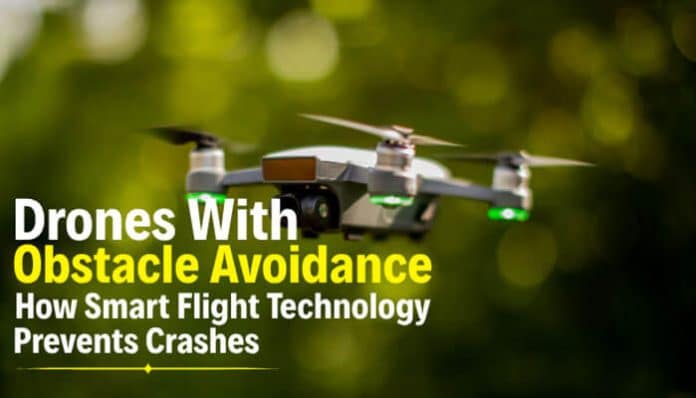
If you’ve ever watched a drone fly straight into a tree branch, you know how expensive a crash can be. A single mistake can turn a $1,000 camera drone into a pile of broken plastic and cracked propellers. That’s exactly why drones with obstacle avoidance have become the standard for anyone who flies seriously, whether that’s a hobbyist filming a hiking trip or a construction company inspecting a rooftop.
In simple terms, drones with obstacle avoidance use small sensors and smart software to “see” what’s around them. When something like a wall, a wire, or a tree branch gets too close, the drone slows down, stops, or steers around it, often before the pilot even notices the danger. This isn’t science fiction anymore. It’s built into almost every mid-range and high-end drone sold today, from beginner-friendly models to professional inspection platforms flying near power lines.
This guide walks through exactly how drones with obstacle avoidance work, which sensor types matter most, how to pick the right model for your needs, and what limitations even the best systems still have. Whether you’re buying your first drone or upgrading to a more advanced one, understanding this technology will help you fly with more confidence and fewer repair bills.
What Are Drones With Obstacle Avoidance?
Drones with obstacle avoidance are aircraft equipped with sensors and onboard computers that detect nearby objects and automatically adjust flight to avoid hitting them. Instead of relying only on the pilot’s eyes and reaction time, the drone constantly scans its surroundings and reacts on its own, often in a fraction of a second.
Think of it like the backup camera and parking sensors on a modern car. The car doesn’t drive itself, but it warns you and can even brake before you back into something. Drones with obstacle avoidance work on the same idea, just in three dimensions and at higher speeds.
There are two main behaviors these systems use:
- Reactive avoidance: The drone detects an object in real time and immediately brakes, stops, or swerves around it.
- Predictive avoidance: The drone builds a live 3D map of the area and plans a path that avoids obstacles before it even gets close to them.
Most modern drones with obstacle avoidance combine both approaches for the best results.
How Do Drones With Obstacle Avoidance Actually Work?
Every obstacle-avoidance system follows the same basic pipeline: sense, process, and react.
1. Sensing: Cameras, lasers, or radio waves collect data about the environment.
2. Processing: An onboard flight computer analyzes that data in real time to identify solid objects.
3. Reacting: The flight controller adjusts speed, direction, or altitude to steer clear of the obstacle.
This entire cycle can happen in well under a second on high-end platforms, since delayed reactions won’t save the aircraft from a fast-moving hazard.
The Main Sensor Types Used in Obstacle Avoidance
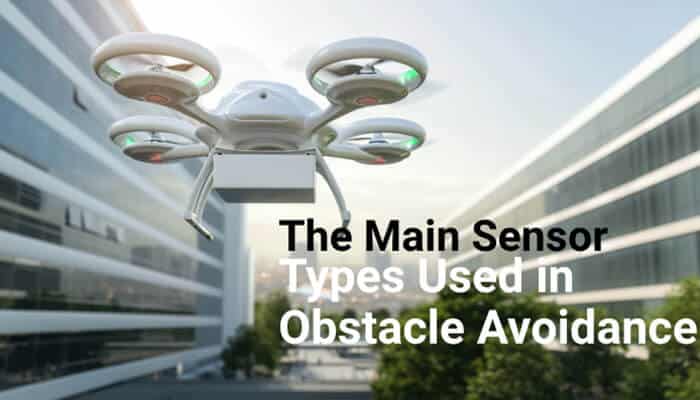
Not all drones with obstacle avoidance use the same technology. Here’s a simple breakdown of what’s inside them.
| Sensor Type | How It Works | Best For | Limitations |
| Vision (Camera) Sensors | Uses pairs of cameras to compare images and judge distance, similar to human eyes | Daytime flying, detailed object recognition | Struggles in low light, fog, or against plain walls |
| Infrared Sensors | Bounce infrared light off nearby surfaces to measure distance | Low-altitude hovering, landing, indoor flying | Short range, less effective in bright sunlight |
| Ultrasonic Sensors | Send sound waves and measure the echo to detect nearby objects | Close-range detection, ground sensing | Very short range, easily confused by soft materials |
| LiDAR | Fires rapid laser pulses to create a precise 3D map of the surroundings | Night flying, detecting thin objects like wires and branches | More expensive and adds weight |
| Radar (Including mmWave) | Uses radio waves to detect objects and measure distance | Fog, rain, dust, and long-range detection | Lower resolution for very small objects |
LiDAR uses laser pulses to generate highly accurate depth measurements and 3D environmental awareness, which improves obstacle detection precision, especially in low-light conditions and close-range navigation. That’s why the newest drones with obstacle avoidance increasingly pair LiDAR with cameras rather than relying on vision alone.
Sensor Fusion: The Real Secret Behind Modern Systems
The biggest leap in drones with obstacle avoidance hasn’t been any single sensor, it’s combining several of them together, a technique called sensor fusion. Sensor fusion is transforming drone obstacle avoidance by combining precise 3D mapping with data from cameras, radar, and ultrasonic devices, allowing drones to detect, classify, and respond to obstacles in real time even in challenging conditions.
Here’s why that matters in plain terms: a camera might miss a thin power line, ultrasonic sensors might get confused by fog, and radar might not clearly outline a small branch. But when a drone cross-checks all of these sensors at once, it builds a far more reliable picture of what’s actually around it. Modern systems can compute collision-avoidance flight paths in as little as 50 milliseconds, letting the aircraft react almost instantly to a sudden obstacle.
Why Obstacle Avoidance Matters More Than Ever
Drone use has exploded, and so has the airspace clutter, trees, buildings, wires, other drones, and even birds. Since roughly 96.5% of drone flights happen below 400 feet, they’re constantly sharing space with exactly the kind of low-altitude hazards obstacle avoidance is designed to catch. That’s precisely the altitude band packed with rooftops, trees, and cables, the everyday hazards that make crashes so common for beginner pilots.
Here’s what good obstacle avoidance actually protects you from:
- Expensive repairs: A cracked gimbal or broken motor can cost hundreds of dollars to fix.
- Lost footage: A mid-flight crash can end a shoot instantly, wasting your time and effort.
- Safety risks: A falling drone near people, cars, or pets can cause real harm.
- Legal trouble: Crashing into private property or public infrastructure can create liability issues.
For professionals real estate photographers, farmers, construction inspectors, and search-and-rescue teams, reliable obstacle avoidance isn’t a luxury feature. It’s what makes flying near buildings, crops, and power lines safe enough to do the job at all.
Types of Obstacle Avoidance Coverage
Not every drone protects you from every direction. When comparing drones with obstacle avoidance, pay attention to how much of the aircraft is actually covered by sensors.
- Forward-only: Basic protection against head-on collisions. Common on entry-level drones.
- Forward and downward: Adds safer landing and low-altitude hovering.
- Multi-directional (front, back, sides): Covers the most common crash directions.
- Omnidirectional (360°): Full coverage in every direction, including above and below.
Beginner drones typically offer forward and downward sensing, which is enough for casual flying in open spaces. If you plan to fly in tight areas, around trees, buildings, or during fast action shots omnidirectional coverage is worth the extra cost.
Popular Drones With Obstacle Avoidance in 2026
The market for drones with obstacle avoidance has matured a lot in the past couple of years. The DJI Air 3S currently offers one of the most advanced obstacle avoidance systems available, combining forward-facing LiDAR with omnidirectional vision sensors, and the DJI Mavic 4 Pro matches that capability with additional tri-camera assistance. Both the Air 3S and the Mini 5 Pro use forward-facing LiDAR specifically to improve safety during night flights.
On the professional end, industrial platforms take things further. The DJI Matrice 400, for example, is reported to fuse rotating LiDAR, mmWave radar, and low-light vision systems to detect thin wires and operate reliably in harsh conditions, a major step up from the basic front-and-rear sensing found on older drones.
A general rule of thumb when shopping for drones with obstacle avoidance:
- Open spaces (fields, beaches, parks): Vision-based omnidirectional sensing is usually enough.
- Urban or wooded environments (buildings, cables, branches): Look for LiDAR or radar-assisted systems.
- Professional inspection work: Prioritize multi-sensor fusion for maximum reliability.
What Obstacle Avoidance Can’t Do (Yet)
No obstacle avoidance system is perfect, and it’s important to fly with realistic expectations rather than blind trust.
- Thin objects are still tricky: Power lines, thin branches, and fishing line can be nearly invisible to some sensors.
- Weather affects performance: Heavy rain, fog, or direct sunlight can reduce sensor accuracy.
- Fast-moving objects are harder to catch: A bird or another drone crossing quickly may not give the system enough time to react.
- Reflective or transparent surfaces confuse sensors: Glass walls and mirrors can trick vision and laser-based systems.
- Obstacle avoidance is not a replacement for piloting skill: Sensors reduce risk; they don’t eliminate the need for a careful, attentive pilot.
Manufacturers are constantly improving these weak spots through better sensor fusion and AI-based object recognition, but pilots should always fly as if the system might miss something because occasionally, it will.
Tips for Getting the Most Out of Your Drone’s Obstacle Avoidance
- Keep firmware updated. Manufacturers regularly improve obstacle detection through software updates.
- Fly in good lighting when possible. Vision-based sensors perform best in daylight.
- Don’t disable safety features to “get the shot.” Many crashes happen right after a pilot manually overrides obstacle avoidance.
- Clean your sensors. Dust or smudges on camera and LiDAR lenses can seriously reduce detection accuracy.
- Understand your drone’s blind spots. Read the manual to know which directions have full sensor coverage and which don’t.
Final Thoughts
Drones with obstacle avoidance have changed what’s possible in the air. They’ve turned flying from a high-stakes balancing act into something far more forgiving, letting beginners build confidence and professionals push closer to buildings, trees, and infrastructure without constant fear of a crash. The technology isn’t flawless, thin wires, bad weather, and fast-moving objects can still catch a system off guard, but the gap between “risky hobby” and “reliable tool” keeps closing every year.
If you’re shopping for your next drone, don’t just look at camera quality. Check the sensor types, the direction coverage, and how the manufacturer describes its obstacle avoidance system. That one feature can be the difference between years of smooth flying and an expensive crash on your very first trip out.
Drones With Obstacle Avoidance FAQs
1. Do all drones have obstacle avoidance?
No. Many budget and toy-grade drones skip this feature entirely to keep costs and weight down. If crash protection matters to you, check the specification sheet before buying.
2. Can obstacle avoidance drones fly indoors?
Yes, many can, especially models with infrared and ultrasonic sensors designed for close-range detection. However, GPS-dependent features may not work well indoors, so check for a dedicated indoor or “vision positioning” mode.
3. Is LiDAR better than camera-based obstacle avoidance?
LiDAR tends to perform better in low light and against thin objects, while cameras are better at recognizing shapes and colors. The best drones with obstacle avoidance use both together rather than relying on just one.
4. Does obstacle avoidance drain the battery faster?
Slightly, since the sensors and processors run constantly during flight. The difference is usually small compared to the safety benefit.
5. Can I turn off obstacle avoidance if I want more flight freedom?
Most drones allow you to disable it for advanced maneuvers like drone racing or cinematic dives. This should only be done by experienced pilots in open, obstacle-free areas.