

DroneUp delivery combines autonomous aircraft, intelligent flight software, and automated infrastructure to transport lightweight packages. Designed to improve last-mile logistics, it offers an alternative to conventional road transportation for urgent orders.
Founded in 2016, DroneUp gained recognition through its former Walmart partnership. However, the company has since shifted toward autonomous operations, enterprise software, and airspace management.
Its evolution offers valuable lessons for businesses exploring faster delivery, operational automation, and sustainable logistics solutions.
What Is DroneUp Delivery?
DroneUp delivery refers to the aerial logistics technology developed by DroneUp, an American technology company headquartered in Virginia Beach, Virginia.
Its original delivery model focused on transporting groceries, household essentials, and other lightweight products using unmanned aerial vehicles (UAVs).
The ecosystem combines autonomous aircraft, automated package handling, intelligent flight planning, real-time monitoring, and remote operational supervision.
Today, DroneUp primarily develops technology that helps commercial operators and aviation authorities manage autonomous aircraft safely and efficiently.
Is DroneUp Delivery Still Available?
As of November 2026, DroneUp’s former Walmart delivery partnership is no longer active. The company’s official website emphasizes autonomous flight operations, regulatory support, and airspace management.
A current, publicly advertised consumer delivery network, standard delivery fees, and direct package-ordering services could not be verified.
Consumers seeking Walmart drone delivery should check their address through Walmart’s website or application. Businesses interested in DroneUp’s enterprise technology can contact the company directly.
DroneUp Delivery at a Glance
| Feature | Details |
|---|---|
| Founded | 2016 |
| Headquarters | Virginia Beach, Virginia, USA |
| Historical delivery fee | $3.99 |
| Historical payload capacity | Up to 10 pounds |
| Announced maximum speed (2024) | 60 mph |
| Announced flight range (2024) | 30 miles |
| Former retail partner | Walmart |
| FAA Part 135 certification | November 2024 |
| Enterprise platforms | Uncrew and ATOMx |
| Current business focus | Autonomous operations and airspace management |
Historical delivery prices and announced aircraft specifications do not represent current service availability or guaranteed operational performance.
History and Evolution of DroneUp
DroneUp’s development reflects the changing priorities of commercial drone logistics.
- 2016: DroneUp was founded in Virginia Beach.
- 2021: Walmart invested in the company.
- 2022: Walmart announced a major drone delivery expansion.
- March 2024: DroneUp introduced its autonomous delivery ecosystem.
- August 2024: Delivery operations were reduced across several markets.
- November 2024: DroneUp received FAA Part 135 operating authority.
- December 2024: Its Walmart partnership ended.
- 2025 onward: The company increasingly emphasized enterprise autonomy and airspace coordination.
This transition highlights the importance of aligning technological capabilities with regulatory requirements and commercial viability.
How Does DroneUp Delivery Work?
DroneUp delivery combines autonomous aircraft, intelligent flight planning, and automated infrastructure to transport lightweight packages efficiently. Its historical delivery process involved the following steps:
- Order placement: Customers select eligible products through a participating retailer.
- Package preparation: Employees securely pack items within aircraft weight limits.
- Flight planning: Software evaluates weather, obstacles, battery levels, and airspace restrictions.
- Drone takeoff: The aircraft launches from an approved delivery hub and follows a planned route.
- Package delivery: A controlled winch lowers the package into the designated delivery area.
- Return and recharge: The drone returns to its station for inspection, charging, and its next mission.
Key Technologies Behind DroneUp Delivery
DroneUp introduced its integrated autonomous delivery ecosystem in March 2024, combining advanced aircraft, automated infrastructure, and intelligent software to improve logistics efficiency. Its key technologies include:
- DBX Automated Delivery Stations: Compact, climate-controlled stations designed for automated package collection, secure storage, and product returns.
- Autonomous Delivery Drones: Aircraft designed with internal package storage, onboard charging, obstacle sensing, and winch-based delivery capabilities.
- Uncrew Operations Platform: Centralized software supporting autonomous mission management, intelligent route planning, and multi-aircraft coordination.
- ATOMx Airspace Management: Technology supporting airspace coordination, situational awareness, policy-driven operations, and threat mitigation.
Together, these technologies reflect DroneUp’s transition from consumer delivery toward broader autonomous aviation infrastructure.
What Happened to the Walmart DroneUp Delivery Partnership?
In May 2022, Walmart announced plans to expand its DroneUp network to 34 sites, potentially reaching four million households across six states:
- Arizona
- Arkansas
- Florida
- Texas
- Utah
- Virginia
The historical service advertised a $3.99 delivery fee, packages weighing up to 10 pounds, and delivery in as little as 30 minutes.
Walmart subsequently reported more than 6,000 completed deliveries across its broader drone program during 2022, involving multiple operators.
However, financial sustainability remained challenging. DroneUp reduced operations in August 2024, and its Walmart contract ended on December 31, 2024. Walmart also confirmed that it was no longer an investor.
What Products Could DroneUp Delivery Transport?
The historical delivery service primarily targeted lightweight groceries, packaged foods, beverages, personal care products, and household essentials.
According to Walmart’s 2022 delivery statistics, popular items across its broader drone program included ice cream, lemons, rotisserie chicken, energy drinks, and paper towels.
Heavy, oversized, hazardous, or restricted products may be unsuitable. Eligibility depends on aircraft capacity, packaging requirements, and aviation regulations.
How Fast and Far Can DroneUp Drones Travel?
DroneUp’s autonomous delivery ecosystem, announced in March 2024, outlined several aircraft capabilities designed to improve the speed and efficiency of last-mile logistics.
| Performance Feature | Announced Capability |
|---|---|
| Maximum speed | 60 mph |
| Total flight range | 30 miles |
| Potential service radius | 15 miles |
| Winch operation | Up to 120 feet |
| Package storage | Internal compartment |
| Charging | Automated onboard charging |
Actual DroneUp delivery performance depends on payload weight, weather conditions, battery reserves, and airspace restrictions. The announced 30-mile flight range does not guarantee a 30-mile one-way delivery or a fixed 15-mile service radius.
Practical Delivery Time Example
Consider a customer located five miles away by air or eight miles away by road.
| Delivery Stage | Drone | Road Vehicle |
|---|---|---|
| Preparation | 5 min | 5 min |
| Transportation | 10 min | 24 min |
| Handover | 3 min | 3 min |
| Total time | 18 min | 32 min |
Assuming average speeds of 30 mph by air and 20 mph by road, the drone delivers the package 14 minutes faster, demonstrating the potential advantages of aerial transportation for urgent orders.
This hypothetical example illustrates potential time savings rather than actual measured DroneUp delivery performance.
How Much Does DroneUp Delivery Cost?
Walmart’s historical $3.99 customer fee did not represent the full cost of fulfilling an order.
In August 2024, DroneUp’s CEO told Axios that a delivery cost approximately $30, with an objective of reducing that figure below $7.
Aircraft maintenance, insurance, charging infrastructure, staffing, flight supervision, and regulatory compliance contributed to operating expenses.
The $7 target was a commercial objective, not a verified achieved result.
Understanding Drone Delivery Profitability
Understanding DroneUp delivery economics helps businesses assess the financial viability of autonomous logistics. Consider a hypothetical retailer with monthly fixed expenses of $12,000 and variable costs of $4 per delivery.
| Monthly Deliveries | Cost per Delivery |
|---|---|
| 500 | $28 |
| 1,000 | $16 |
| 2,000 | $10 |
| 4,000 | $7 |
| 6,000 | $6 |
Cost per Delivery = (Fixed Expenses ÷ Completed Deliveries) + Variable Cost per Delivery
Higher delivery volumes can reduce average costs when fixed expenses remain stable. However, profitability depends on revenue, maintenance, staffing, and infrastructure expenses.
These illustrative calculations do not represent DroneUp’s actual financial results.
Benefits of DroneUp Delivery Technology
- Faster delivery: Direct flight routes can reduce transportation time for urgent lightweight orders.
- Operational efficiency: Automation can reduce repetitive package handling and mission management tasks.
- Customer convenience: Eligible products can reach customers without requiring a store visit.
- Improved accessibility: Authorized flights could serve selected locations that are difficult to reach by road.
- Environmental potential: A 2022 study published in Patterns found that small drones delivering very lightweight packages could consume up to 94% less energy per package than certain alternative vehicles.
Environmental savings depend on electricity sources, payload, flight distances, and the transportation method being replaced.
DroneUp Delivery vs. Traditional Delivery Services
| Feature | Drone Delivery | Traditional Delivery |
|---|---|---|
| Speed | Fast for short routes | Traffic-dependent |
| Payload | Limited | Higher capacity |
| Weather sensitivity | Higher | Generally lower |
| Coverage | Authorized areas | Extensive networks |
| Order capacity | Limited | Multiple packages |
| Best use | Urgent small orders | Routine and bulk orders |
Drones are particularly useful for time-sensitive deliveries, while conventional vehicles remain efficient for larger shipments and consolidated delivery routes.
Infrastructure Required for Drone Delivery
Commercial drone logistics requires suitable delivery hubs, charging systems, secure package storage, communication networks, weather monitoring, and maintenance facilities.
Businesses must also consider local zoning, environmental requirements, aviation permissions, insurance, and emergency procedures.
Backup ground transportation is essential when weather conditions, equipment failures, or operational restrictions prevent flights.
Industries That Can Benefit From DroneUp Technology
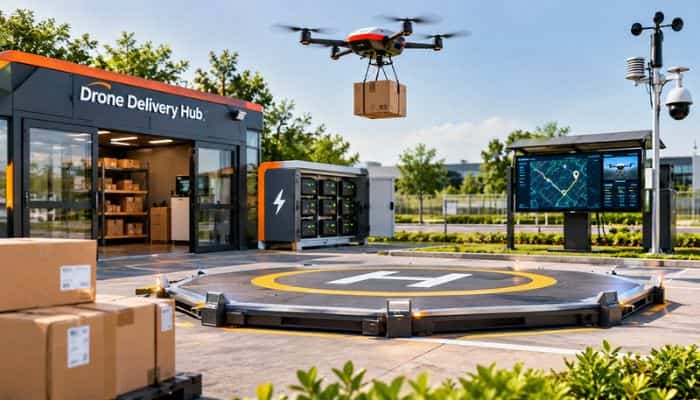
Autonomous aviation technology offers potential applications across multiple sectors:
- Retail and e-commerce: Urgent grocery and household orders.
- Healthcare: Transportation of approved medical supplies.
- Restaurants: Selected lightweight food deliveries.
- Manufacturing: Urgent replacement parts and equipment.
- Agriculture: Samples, monitoring, and lightweight supplies.
- Emergency services: Time-sensitive materials and operational support.
These represent potential applications rather than a confirmed list of active DroneUp delivery services.
FAA Regulations and DroneUp Delivery Safety
In November 2024, DroneUp became the sixth US drone operator to receive FAA Part 135 operating authority, launching package delivery operations with its Prism V2 aircraft in Murphy, Texas.
Operators must comply with aircraft maintenance, airspace permissions, flight supervision, and aviation safety requirements. Certification does not authorize unrestricted flights.
How FAA Part 108 Could Change Drone Delivery
The proposed FAA Part 108 framework aims to standardize Beyond Visual Line of Sight (BVLOS) operations, potentially supporting larger commercial drone fleets.
As of November 17, 2026, the final rule remained under federal regulatory review. Once effective, the new framework could support safer and more scalable autonomous logistics.
DroneUp vs. Wing vs. Zipline vs. Amazon Prime Air
DroneUp delivery differs from other commercial drone delivery solutions in its business strategy, technological capabilities, and operational focus. The following comparison highlights their primary differences.
| Company | Primary Focus | Key Strength |
|---|---|---|
| DroneUp | Enterprise drone technology | Airspace coordination |
| Wing | Consumer delivery | Retail partnerships |
| Zipline | Medical and retail logistics | Specialized delivery systems |
| Amazon Prime Air | E-commerce delivery | Integrated retail ecosystem |
While its competitors primarily focus on package transportation, DroneUp increasingly emphasizes autonomous flight management, enterprise software, and airspace coordination. This strategic direction differentiates the company within the commercial drone industry.
Challenges and Limitations of DroneUp Delivery
Despite its technological advantages, DroneUp delivery technology and the broader drone logistics industry face several operational, financial, and regulatory challenges.
| Challenge | Potential Impact |
|---|---|
| High operating costs | Profitability pressure |
| Payload restrictions | Limited product selection |
| Weather disruptions | Delayed or canceled flights |
| Battery limitations | Restricted flight range |
| Aviation regulations | Expansion barriers |
| Noise and privacy | Community concerns |
| Cybersecurity risks | Operational vulnerabilities |
Overcoming these challenges requires reliable aircraft, secure communications, transparent privacy practices, regulatory compliance, and responsible community engagement. Businesses must also balance operational expenses with customer demand to achieve sustainable growth.
Why Did DroneUp Change Its Business Strategy?
DroneUp’s historical business model depended substantially on commercial delivery partnerships. High operating costs and limited scale exposed the difficulties of building financially sustainable consumer delivery networks.
The company now emphasizes autonomous fleet management, regulatory support, enterprise technology, and airspace coordination.
This approach could create diversified commercial opportunities without depending entirely on individual package delivery fees. Current enterprise pricing, revenue breakdowns, and profitability remain unverified.
How Businesses Can Implement Drone Delivery Technology
Businesses exploring DroneUp delivery technology or similar autonomous logistics solutions should evaluate customer demand, operational requirements, regulatory compliance, and financial feasibility before investing in infrastructure.
| Implementation Step | Objective |
|---|---|
| Assess customer demand | Identify genuine needs |
| Select eligible products | Match aircraft capacity |
| Evaluate routes and hubs | Confirm operational feasibility |
| Calculate operating costs | Test financial viability |
| Obtain approvals and insurance | Ensure compliance |
| Integrate ordering systems | Coordinate fulfillment |
| Conduct pilot operations | Measure performance |
| Expand gradually | Minimize investment risks |
Businesses should monitor key performance indicators (KPIs), including cost per successful delivery, order completion rates, average delivery time, aircraft utilization, weather-related cancellations, and customer retention.
Companies should also maintain backup ground transportation to prevent service disruptions. Expansion should occur only when pilot results demonstrate measurable customer value, operational reliability, and sustainable operating costs.
Future of DroneUp Delivery in Logistics
The future of DroneUp delivery increasingly revolves around autonomous aviation, enterprise software, and intelligent airspace management. On November 5, 2026, Walmart reported surpassing two million drone deliveries and announced plans to add 300 Zipline sites, highlighting industry growth rather than DroneUp’s individual achievements.
Potential growth opportunities for DroneUp include:
- Autonomous fleet management: Efficient coordination of multiple aircraft.
- Intelligent airspace management: Safer and more coordinated flight operations.
- Hybrid delivery networks: Integration of drones with conventional transportation.
- Industrial applications: Infrastructure monitoring and automated inspections.
- Healthcare logistics: Supporting time-sensitive medical transportation.
DroneUp’s long-term success will depend on regulatory advancements, operational safety, system interoperability, customer adoption, and cost efficiency.
Key Business Lessons From DroneUp Delivery
DroneUp delivery demonstrates that technological innovation alone cannot guarantee commercial success. Businesses must validate customer demand, control operating costs, prioritize regulatory compliance, and diversify revenue opportunities.
The greatest value of autonomous logistics lies in solving specific delivery challenges where speed, accessibility, and urgency justify the investment.
Conclusion
DroneUp delivery demonstrates both the opportunities and challenges of autonomous logistics. Its transition from retail delivery toward enterprise software and airspace management highlights the importance of adapting technology to commercial needs.
As automation advances and aviation regulations evolve, DroneUp could contribute to safer, more efficient, and scalable autonomous operations. Its long-term success will depend on delivering measurable business value while maintaining operational safety and sustainable costs.
DroneUp delivery FAQs
1. Can DroneUp delivery technology support different drone brands?
Yes. DroneUp’s Uncrew platform supports compatible aircraft from different manufacturers through standardized communication protocols.
2. Does DroneUp delivery technology include operator training?
DroneUp offers training, regulatory consulting, and operational support to help businesses implement autonomous drone operations.
3. Can customers track DroneUp delivery orders in real time?
Current DroneUp consumer tracking services remain unverified. However, Walmart’s active drone delivery program supports real-time order tracking.
Disclaimer
This article is for informational purposes only. DroneUp delivery availability, pricing, aircraft specifications, and aviation regulations may change. Financial examples are illustrative and do not represent actual company results.
