
You are sitting in your backyard, enjoying a quiet Sunday afternoon. Suddenly, you hear that familiar buzzing sound above your head. You look up and spot a drone hovering right over your house. It feels wrong. It feels invasive. And if you are like most homeowners wondering how to stop drones from flying over your house, your first thought is, ” Can I stop this?
This is not a rare situation anymore. Drones have become incredibly common in the last few years. Hobbyists fly them for fun. Real estate agents use them for photography. Delivery companies are testing them for package drops. But not every drone flying near your home has a good reason to be there. Some are flown carelessly. Others might actually be spying on you. Either way, you have every right to feel concerned about your privacy and your property.
The good news is that there are real, legal, and effective ways to handle this. Learning how to stop drones from flying over your house does not have to be complicated. This guide will walk you through everything from understanding your legal rights to using physical barriers, reporting options, and smart technology. No confusing jargon. No risky advice. Just clear, step-by-step solutions that actually work.
Why Drones Keep Flying Over Your House
Before jumping to solutions, it helps to understand why drones end up above your home in the first place. There are several common reasons:
- Hobbyist flying: Many drone owners are simply having fun and may not realize how close they are getting to private property.
- Real estate photography: Agents and photographers use drones to capture aerial shots of homes and neighborhoods.
- Surveying and mapping: Government agencies and private contractors sometimes fly drones to survey land and property lines.
- Delivery testing: Companies like Amazon and Wing have been expanding drone delivery in residential areas.
- News and journalism: Media outlets sometimes use drones to capture footage of events or neighborhoods.
- Deliberate surveillance: Unfortunately, some drones are flown with the intent to spy on people in their homes or yards.
The reason matters a lot. A lost delivery drone is a very different situation from someone intentionally hovering over your backyard with a camera. Your response should match the situation.
Is It Legal for Drones to Fly Over Your Property?
This is where things get a little tricky. In the United States, the Federal Aviation Administration (FAA) controls the airspace above your home, not you. That means, technically, drones can legally fly over your property as long as they follow FAA rules.
However, that does not mean anything goes. Here is what the law actually says:
| Rule | What It Means for You |
| FAA controls airspace | Drones can legally fly above a certain altitude without your permission |
| Recreational drones must stay below 400 feet | Most hobby drones fly within this range near your home |
| Commercial operators need FAA Part 107 certification | Professional drone pilots must follow strict rules |
| State and local laws still apply | Many states have privacy and nuisance laws that protect you |
| Drones cannot fly over people without a waiver | FAA rules limit flying directly over individuals |
The key takeaway is that while the FAA sets altitude rules, privacy laws and local ordinances can give you much stronger protection at the ground level. Many states have passed laws specifically targeting drone surveillance of private property.
Your Privacy Rights as a Homeowner
Even if a drone is flying in “legal” airspace, your privacy rights still matter. Courts have recognized that people have a reasonable expectation of privacy in their backyards, inside their homes, and in spaces not visible to the general public.
Here are some legal protections that already exist:
- Wiretapping and surveillance laws: Several states make it illegal to record someone on private property without consent.
- Voyeurism statutes: Recording someone in a private area (like a backyard pool) without permission can be a criminal offense.
- Harassment laws: If a drone repeatedly flies over your home to intimidate or disturb you, that may qualify as harassment.
- Trespassing laws: Some states have extended trespass law to apply to drones flying at low altitudes over private property.
- Nuisance law: Even without criminal charges, you may have civil remedies if a drone is interfering with your enjoyment of your property.
Always check your specific state laws. Privacy protections vary a lot from state to state, and some cities have their own drone ordinances too.
How to Stop Drones from Flying Over Your House: Legal Methods
Now here is the part you came for. These are the most effective legal ways to handle drones over your home.
1. Talk to the Drone Pilot Directly
This sounds simple, but it works more often than people expect. Many drone pilots, especially hobbyists, do not realize they are bothering anyone. A calm, polite conversation can resolve the problem instantly.
- Approach the person in a non-threatening way
- Explain that you feel uncomfortable with the drone flying near your home
- Ask them to redirect their flight path away from your property
- Most reasonable people will comply without any drama
If the person refuses or becomes hostile, that is when you move to other steps.
2. Post “No Drone Zone” Signs
Putting up visible signs around your property sends a clear message. While signs alone cannot legally stop a drone, they:
- Establish that you have made your position clear
- Create a record that the pilot was warned
- Deter casual flyers who just want to avoid conflict
- Strengthen any legal case you build later
You can find “No Drone Zone” signs at hardware stores and online. Place them at entry points and open areas of your yard.
3. Use Privacy Landscaping
One of the most effective (and beautiful) long-term solutions is to block the view from above using natural elements.
Options include:
- Tall trees like Leyland cypress, arborvitae, or bamboo
- Privacy hedges along your fence line
- Pergolas and shade structures with solid roofing
- Shade sails or pergola covers that block overhead views
- Patio umbrellas for smaller outdoor areas
This approach does not stop a drone from flying over, but it eliminates the view into your private spaces, which is often the real concern.
4. Install Privacy Screens and Enclosures
For immediate results, physical enclosures work well:
- Retractable pergola covers: Block overhead views without a permanent structure
- Privacy screens: Attach to existing fences for fast coverage
- Shade cloth netting: Affordable and easy to install over garden areas
- Outdoor canopy tents: Perfect for patios and seating areas
These are great options for renters who cannot plant trees or build permanent structures.
5. Contact Your Local Government
If drones are a recurring problem in your neighborhood, it is worth getting local authorities involved.
- Contact your city council or county representative
- Ask about local drone ordinances (many cities already have them)
- Push for a community “no fly zone” designation if your area qualifies
- Join neighborhood associations and raise the issue collectively
Local governments have more authority than many people realize, and organized community pressure often leads to real policy changes.
6. Apply for an FAA-Designated No Fly Zone
In certain situations, like homes near airports, sensitive facilities, or with documented safety concerns, you can petition for an official FAA no-fly zone designation. This is a longer process but provides the strongest protection.
The FAA’s LAANC (Low Altitude Authorization and Notification Capability) system also allows authorities to restrict airspace in specific areas. Talk to a local aviation authority or legal professional for help with this process.
Physical Barriers That Work
Sometimes the best defense is a good physical setup. Here are structures and barriers that help limit drone access to your private spaces:
Privacy Fencing
- Tall wooden or vinyl privacy fences (6–8 feet) reduce the angle from which drones can see into your yard
- Lattice-top extensions add extra height legally in many areas
- Solid fence panels are more effective than chain link or open designs
Overhead Netting
Netting systems are used in gardens, sports facilities, and even backyards to block access from above.
- Use fine mesh netting strung between poles or fence posts
- Make sure any netting system is clearly visible to avoid drone entanglement (which has its own legal complications)
- This works well for pool areas, vegetable gardens, and play zones
Canopy Structures
Permanent or semi-permanent covered structures eliminate overhead visibility entirely:
- Solid-roof pergolas
- Patio covers attached to the house
- Greenhouse-style enclosures for garden areas
These add value to your home while also giving you complete privacy from above.
Technology-Based Solutions
Technology can help you detect, document, and in some cases deter drone activity near your home.
Drone Detection Systems
Several systems are now available for residential use that alert you when a drone enters your airspace:
- DroneWatcher App: Detects nearby drones using your smartphone and a compatible sensor
- D-Fend Solutions and similar platforms: More advanced detection used by property managers and HOAs
- Radio frequency (RF) detectors: Detect the communication signals between a drone and its operator
These tools help you know exactly when a drone is present and give you documentation for any complaints or legal action.
Security Cameras
Installing your own cameras does two important things:
1. Documents drone activity with timestamps and footage
2. Creates a record of repeated violations that you can take to authorities or court
Position cameras to capture the sky above your property. Wide-angle or 360-degree cameras work best for this purpose.
Smart Home Integration
Some smart home systems can trigger alerts when unusual aerial objects are detected nearby. Pairing detection sensors with smart speakers or phone notifications means you will never miss drone activity, even when you are inside.
What About Drone Jammers?
You have probably seen articles about signal jammers that can interrupt a drone’s connection and force it to land. While these sound appealing, they are federally illegal for civilians to use in the United States under the Communications Act. The FCC and FAA both prohibit jamming of any radio frequencies, including those used by drones.
Using a jammer even to protect your privacy can result in criminal charges. Stick to the legal methods in this guide.
How to Report Drone Violations
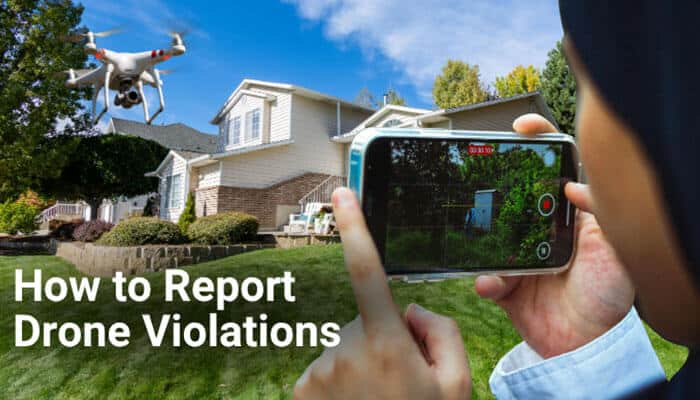
If a drone is harassing you, invading your privacy, or flying unsafely, you have several reporting options:
Report to the FAA
- Go to faa.gov and use the online complaint system
- Call the FAA Drone Hotline: 1-844-FLY-MY-UA (1-844-359-6982)
- Provide footage, dates, times, and location details
Report to Local Law Enforcement
- If you believe a drone is being used to spy on you, call your local police department
- Bring any video evidence you have
- Reference specific state privacy or surveillance laws when you file the report
- Ask the officer to document the incident even if they cannot take immediate action
Report to the FAA’s Safety Hotline
For commercial drone operators violating Part 107 rules (flying over people, at night without waivers, etc.), the FAA can investigate and take enforcement action.
Report to Your HOA
If you live in a community with a Homeowners Association, check whether your HOA has drone policies. Many HOAs have adopted rules that prohibit drone flights within the community, giving you another enforcement avenue.
Document Everything
Whenever a drone appears:
- Record video with your phone immediately
- Note the exact time, date, and location
- Try to capture the direction the drone came from and where it went
- If you can identify the operator, document that too
- Save all of this in a folder in case you need it later
What You Should NEVER Do
There are some responses to drone intrusion that feel satisfying but will land you in serious legal trouble. Avoid these completely:
- Shooting down a drone: This is a federal crime. Drones are considered aircraft, and destroying one can result in criminal charges, including destruction of aircraft and reckless endangerment.
- Using signal jammers: Illegal under federal law, as mentioned above.
- Physically confronting a pilot aggressively: This can escalate into assault charges.
- Tampering with someone else’s drone: Any physical interference with a drone, even catching it, can be considered destruction of property.
- Throwing objects at a drone: This is dangerous and illegal.
The frustration is completely understandable, but the legal methods in this guide will protect you far better than any of these dangerous shortcuts.
State-by-State Drone Laws
Drone laws vary significantly across the US. Here is a quick look at where some states stand:
| State | Key Drone Privacy Law |
| California | Drones cannot be used to photograph or record people in private spaces without consent |
| Texas | Texas Privacy Act illegal to capture images of private property without consent |
| Florida | Drones cannot be used for surveillance of a person or their property without consent |
| North Carolina | Unlawful to use drones to observe private persons without their consent |
| Oregon | Drones cannot hover over private property below 400 feet to conduct surveillance |
| Nevada | Trespass law extended to include drones in some situations |
| Utah | Drone surveillance of critical infrastructure is prohibited |
| New York | Various local ordinances restrict drone use in residential areas |
Always verify current laws in your state, as drone legislation is evolving fast. A local attorney familiar with privacy or aviation law can give you specific guidance.
Quick Reference: Solutions at a Glance
| Method | Cost | Effectiveness | Legal? |
| Talk to the pilot | Free | High for casual flyers | Yes |
| Privacy landscaping | Medium–High | Very high long-term | Yes |
| Privacy fencing | Medium | High | Yes |
| Overhead netting | Low–Medium | High for covered areas | Yes |
| Drone detection app | Low | High for monitoring | Yes |
| No Drone Zone signs | Low | Moderate deterrent | Yes |
| Security cameras | Medium | High for documentation | Yes |
| FAA complaint | Free | Moderate–High | Yes |
| Signal jammer | N/A | N/A | ILLEGAL |
| Shooting the drone | N/A | N/A | ILLEGAL |
Final Thoughts
Knowing how to stop drones from flying over your house is not about being anti-technology or making life difficult for responsible drone pilots. It is about protecting something fundamental, your right to privacy in your own home and on your own property.
The best approach combines several strategies together. Post clear signs. Use natural and physical barriers to block overhead views. Install detection technology to know when drones are present. Document every incident carefully. And when you need to escalate, use the proper legal channels local authorities, the FAA, and if necessary, an attorney.
The law is on your side more than you might think. And the tools available to homeowners in 2026 make it easier than ever to protect your space without doing anything illegal or dangerous.
You deserve peace and privacy in your own home. Start with one or two of the solutions in this guide today, and build from there.
How to Stop Drones from Flying Over Your House FAQs
1. Can I legally destroy a drone flying over my house?
No. Under federal law, drones are classified as aircraft. Destroying one by any means is a federal offense that can result in criminal charges, fines, and even prison time.
2. Does a drone need permission to fly over my backyard?
The FAA controls airspace, so technically no, but your state’s privacy laws may give you protection if the drone is recording or surveilling you without consent.
3. What altitude can drones legally fly near homes?
Recreational drones must stay below 400 feet AGL (above ground level) in uncontrolled airspace. Local rules may be stricter in residential areas.
4. Can I sue someone for flying a drone over my house?
Potentially, yes, especially if you can prove invasion of privacy, harassment, or stalking. Consult a local attorney who handles privacy cases.
5. Is there a national no-fly zone registry for private homes?
Not specifically for private homes. However, certain areas (near airports, military bases, national parks) are designated no-fly zones. Some states allow individuals to petition for local restrictions.
6. What should I do if I see a drone with a camera hovering near my window?
Record it immediately, then call local law enforcement and file a complaint with the FAA. This may qualify as illegal surveillance under your state’s laws.
7. Can an HOA ban drones in a neighborhood?
Yes. HOAs have the authority to create rules that restrict drone use within their community, as long as those rules comply with state law.
8. Will a privacy fence stop a drone from seeing into my yard?
It reduces visibility from certain angles but not from directly above. Combine fencing with overhead covers or landscaping for full privacy.